
The Etruscan name of Vulci is Velch or Velx, and it is an Etruscan city, later colonized by the Romans, located in the Maremma area of Lazio between the municipalities of Canino and Montalto di Castro, in the province of Viterbo. It lies about 10 km (6.2 mi) from the Tyrrhenian Sea.
Vulci is located on a large plateau of approximately 120 hectares (about 296 acres) and is one of the most important city-states of Etruria and likely part of the Dodecapolis, the sacred league of the twelve Etruscan cities.
In Vulci, there is evidence of habitation dating back to the late Bronze Age, thus before 1000 BCE, with settlements such as Pian di Voce. Other remains date back to the Iron Age and are presumably the traces of the foundation of the city of Vulci. The area was rich in mineral deposits such as copper, lead, and iron.
Contacts with the ancient peoples of Sardinia
The Tomb of the Bronzes is evidence of direct contacts with the Nuragic peoples; numerous bronze statuettes typical of Sardinian culture depicting human figures, animals, and ships were found inside it.
Contacts with the Greek world
Numerous fragments and whole vases of Corinthian, Ionian, and Attic pottery were also found, demonstrating intense trade relations with the Greek colonies of Southern Italy and the Aegean.
Main Necropolises
Ponte Rotto
Within the Ponte Rotto necropolis, one of the most famous Etruscan tombs was found, with wall paintings depicting Greek myths and Etruscan historical figures.
Osteria
Within the Osteria necropolis, the Tomb of the Sun and Moon, the Campanari Tomb, and the Sphinx Tomb were discovered.
Mandrione di Cavalupo
Inside it, the Tomb of the Sardinian Bronzes was found, which demonstrates the influence and presence of women of Sardinian origin in the local community—possibly through political marriages or alliance relationships. This is an important detail in the analysis of the traces of one or more ancient maritime peoples who arrived in the Mediterranean.
Poggetto Mengarelli
Containing pit tombs inside which there are ceramics and bronze objects dating to around the eighth century BCE.
Tumulo della Cuccumella
This is the largest burial mound in Etruria, with its 18 meters (59 ft) in height and 70 meters (230 ft) in diameter.
City walls and buildings
The city was fortified and had at least 5 access gates, and contained a series of important building.
Great Temple: located along the axis of the decumanus (a road in ancient Rome that ran from East to West). It measured 36.4 meters (119.4 feet) in length and 24.6 meters (80.7 feet) in width, making its proportions approximately 2:3 (almost perfect). Inside, it featured a cella—15 meters (49.2 feet) long and 10 meters (32.8 feet) wide—dedicated to the deity to whom the temple was consecrated (believed to be Minerva). In this case, the ratio is exactly 2:3.
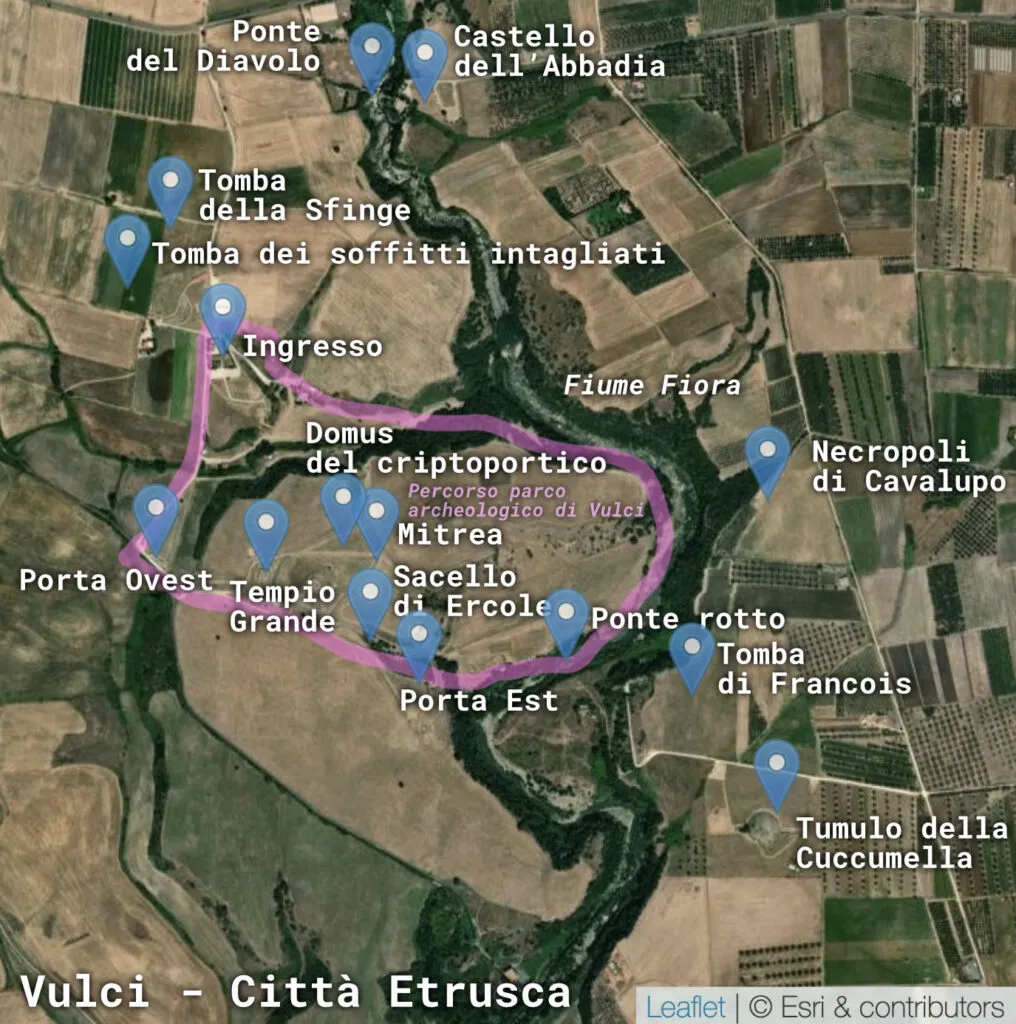
Domus of the Cryptoporticus: a noble residence equipped with a cryptoporticus, an underground area carefully designed to regulate ventilation and illumination by allowing sunlight to pass through
Mithraeum: sanctuary dedicated to the cult of Mithras
Fisherman’s House: inside which objects related to fishing activities were found
Sanctuary of Hercules: a small temple just outside the East Gate, inside of which votive bronzes dedicated to the hero were found
Other notable monuments
- Devil’s Bridge: Roman bridge 20 meters (66 ft) high over the Fiora River
- Castle of the Abbadia: a medieval structure built above the archaeological area, today home to the museum and entrance to the park. You reach the castle by crossing the Ponte dell’Abbadia, a structure that showcases the Etruscans’ remarkable ability to work stone in the construction of impressive engineering works.