
The cultural analysis of early Rome, the origins of some of its kings, and the archaeological evidence now clearly demonstrate the significant Etruscan presence in its foundation. In this article, we explore several of these aspects, with a focus on specific ancient rituals.
As we know, we can trace the founding of the Roman Empire through two pillars: the historical one and that of myth and legend.
From a historical perspective, scholars agree that Rome was founded from the union of several Latin and Sabine villages located on the hills around the Tiber, especially the Palatine, and then the Celio and Quirinal hills.
Organized groups dating back to the 9th-8th century BC in these areas were dedicated to trade and cultural exchanges, taking advantage of the proximity to the Tiber. Let us remember that across part of the Western Mediterranean, there was Sardinia, and the Nuragic people often engaged in trade with populations to their East, including the Etruscans.
According to many archaeologists, including Andrea Carandini, one of the foremost experts on archaic Rome, the Etruscans played a direct role in the urban development of Rome between the 8th and 6th centuries BC. Carandini, for example, interpreted some structures found at the foot of the Palatine (such as the so-called “House of Romulus”) as signs of an already advanced urban organization, compatible with Etruscan influences. He also concluded that an Etruscan king – probably Tarquinius Priscus – might have directed the works of the great drainage system of the Forum, the Cloaca Maxima. This thesis is further explored in his book La nascita di Roma: Dei e uomini alle origini della città, published by Einaudi in 1997.
In the area of the Roman Forum, near the Palatine, remains of huts, burials, and artifacts compatible with Etruscan culture have been found, including ceramics and objects decorated in Etruscan style.
The architectural decorations of the first temples (such as those on the Capitoline Hill and the Forum Boarium) show styles typical of the Etruscans.
The National Etruscan Museum of Villa Giulia hosts Etruscan artifacts from Rome itself, although most of the collections come from important Etruscan centers such as Veii, Cerveteri, and Vulci.
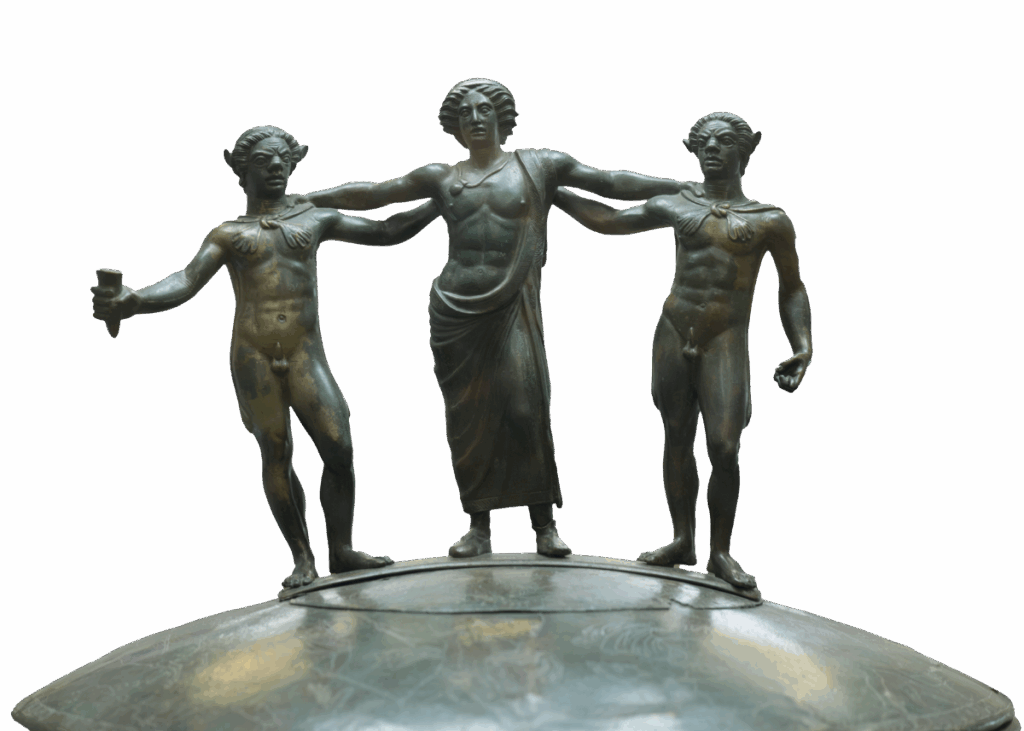
A significant example is the Cista Ficoroni, a 4th-century BC bronze jewelry box, made by Novios Plautios, an artisan who, as indicated by the inscription on the object, made it in Rome.
“DINDIA MACOLNIA FILIAE DEDIT / NOVIOS PLAUTIOS MED ROMAI FECID,” which means
“Dindia Macolnia gave it to her daughter / Novios Plautios made it in Rome”
According to scholars, both Tarquinius Priscus and Servius Tullius were Etruscans; according to The History by Titus Livius, Tarquinius Priscus was at least of Etruscan origin; he had the Circus Maximus and the Cloaca Maxima built.
Servius Tullius is another Etruscan king and is often associated with the political and social reform of Rome. Legend has it that he was the son of an Etruscan prince.
After the fall of Troy – according to the myth – Aeneas took refuge with his father Anchises and his son Ascanius on the coasts of Lazio, where the Trojan lineage continued. The son Ascanius founded Alba Longa, from which Numitor descended, who was overthrown by his brother Amulius. To prevent heirs to the throne, Amulius forced his niece Rhea Silvia, daughter of Numitor, to become a priestess. But the god Mars united with her, and the twins Romulus and Remus were born, destined to found Rome.
In mythological terms, Rome would thus descend from Venus, mother of Aeneas, and Mars, father of Romulus and Remus. Where can we push ourselves to reconstruct the origins of Etruria?
Professor Carandini from La Sapienza University and archaeologist gave an important lecture on the studies concerning the Foundation of the Eternal City Rome.
Romulus had positioned himself on the Aventine Hill to perform a ritual related to the foundation of Rome and to understand whether the gods were in favor. He then hurled a cornel spear toward the Palatine Hill, symbolizing conquest in claiming the area to found the city. The spear, embedding itself into the ground, caused a tree to grow—an omen that the gods were on his side.
He realized that the Latin rituals were not sufficient to found the city and involved the Etruscans, who had a true manual containing all the necessary rituals for founding a city.
At this point, he moved to the Palatine and faced Mount Albanus. From there he could see Alba Longa, the land of the Latins on the horizon. He built his house in front of the place where he had been raised and celebrated the Parilia (the festival of April 21st) there.
In symbolically creating the first land of Rome on which to light a propitiatory fire, two important gestures:
He lit the fire and pronounced the known name of Rome as well as the secret names of the city.
While gathering the necessary information to write and enrich this page, I had the unpleasant surprise of encountering something I personally hoped not to find in either Etruscan or Roman culture: propitiatory human sacrifice. Professor Carandini explains that—according to the findings of his research team—some discoveries in the areas where Romulus is said to have performed the rituals for founding the city suggest the sacrifice of a young girl, who was then buried in the referenced area.
Many of us, in becoming passionate about ancient myths and legends, may have noticed that echoing—almost in parallel to what we directly read—is the idea that in antiquity, so-called barbarians performed bloody sacrificial rites to their gods. This concept is present when we think of Vikings, Celts, or generally barbaric peoples, but it also applies to all those cultures our Western civilization—especially following Columbus’ explorations of the Americas—classified as indigenous.
If we trace this cultural evolution back to ancient peoples in our imagination, we often represent pre-Olympian cults (Titans and others) as violent and sacrificial, while those of the Greek and Roman civilizations appear in line with our modern moral boundaries. A striking example is the representation of the god Saturn—especially in his Greek form, Cronus—depicted as a devourer of humans. A Titan, in fact, preceding the new divine hierarchy led by Zeus (Jupiter) and his siblings.
Why this brief insight into sacrifice is important:
Therefore, we must not discard the more unpleasant elements, as tempting as it may be. On this subject, the website omero.it features a statement by Professor Carandini and the following words in particular:
A sense of horror spreads through the room:
“But why these sacrifices?” someone asks from the audience.
“To win the favor of the gods,” replies the professor. “Mind you, the founding act of a city is accompanied by rituals of profound meaning: one must appease the gods, one must somehow calm the wrath of local spirits disturbed by the alteration of the natural order that the creation of a new urban settlement entails.”
“And to do that, is it necessary to kill children?”
“Sacrifice is an offering to the god, and what do we usually offer to a god? That which is dearest to us. And what is dearer than a child?”
“Nothing,” murmurs someone behind us
These are questions we try to answer with the emotional detachment necessary to maintain the thread of reasoning:
We know that official historical theory holds that man, needing the divine, imagined it. We must then ask ourselves why such an idea would lead to building pyramids, sacrificial altars, and performing such rituals.
Hoping to inspire reflection, and always with the intent to maintain an analytical approach, we recall that Jesus, in John 8, states something very concrete:
Why do you not understand what I say? It is because you cannot bear to hear my word. You belong to your father, the devil, and you want to carry out your father’s desires. He was a murderer from the beginning and has not stood in the truth, because there is no truth in him. When he lies, he speaks his native language, for he is a liar and the father of lies.
We also recall the well-known passage in which he clearly states that no harm should be done to children. Each person, in full peace of mind, is free to interpret his words either as a cultural transition or in deeper, theological terms.
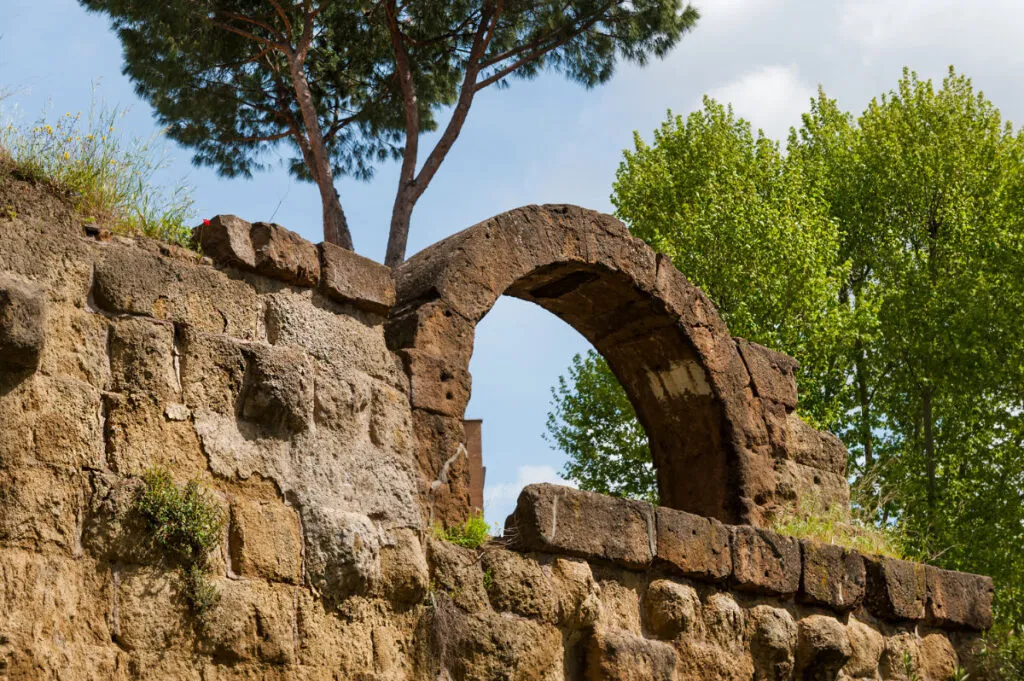
Another proof of Etruscan influence on early Rome is represented by the Servian Walls, a vast defensive system built from tuff blocks during the reign of Servius Tullius, one of Rome’s Etruscan kings (6th century BCE).
Although the name “Servian” derives from this tradition, many scholars believe the walls were expanded or rebuilt in later periods; however, the first phase of construction aligns with an urban vision that reflects methods and models typical of Etruria, most likely dating back to the 6th century BC.
The use of large, regularly cut tuff blocks and the monumentality of the structure point to advanced technical knowledge, also found in the fortifications of contemporary Etruscan cities such as Veii, Cerveteri, and Tarquinia. The urban and defensive organization of archaic Rome was deeply influenced by the Etruscan world—in religion and foundational rites, infrastructure, and architecture.
We briefly analyzed the history and myth surrounding the birth of ancient Rome, and much evidence seems to suggest that the Roman Empire derived from older knowledge and skills passed down by the Etruscans.
But the most interesting aspect in the thread we are trying to trace concerns the possible connection — at least in part — between Troy, Etruria, and Rome. Remembering that even in ancient Greece there were many social classes and micro-realities, we can hypothesize that the Etruscans — themselves later divided into classes (just like the Patricians and Plebeians of ancient Rome) — belonged to a noble lineage.
We have followed a path that seems to culminate with Christianity about seven hundred years later, in which society felt the need to define very important moral boundaries, turning the page on certain traditions of the past. While we are aware that in the following 2000 years, countless mistakes would be made in the name of that emerging culture — perhaps due to not following its original message closely enough.
We must accept the fact that things we consider unacceptable today might have been normal in the past, and always try to interpret historical findings within their original context.
It’s also important to note, as Andrea Carandini himself reported, that the Etruscans were probably (among) the first great builders of the Mediterranean area, perhaps even predating the Greeks. And that the subsequent points of contact between the two peoples likely occurred later.
The birth of Rome is therefore certainly the result of the union of many cultures, among which the Etruscan culture played a decisive role.