
By analyzing the layers of the Ponte dell'Abbadia, details emerge that suggest a more advanced Etruscan architecture than what is typically attributed to the mysterious people who inhabited Tuscany and Lazio before the Romans.
When we think of the Etruscans, we picture their extraordinary artistic ability, expressed in enchanting sculptures and paintings, as well as in the crafting of swords, helmets, and shields with a fairytale-like appearance. We also recall their skill in creating tuff masonry works; just think of the wonderful walls and tumuli spread across northern Lazio and Tuscany.
However, we often do not perceive the Etruscans as a people capable of carrying out significant engineering works.
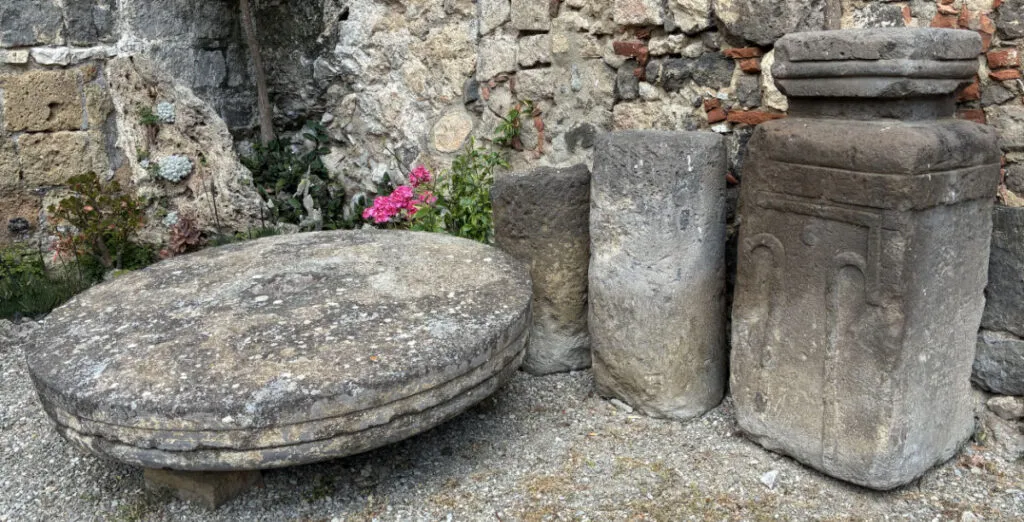
The Etruscans, as can be seen from these artifacts preserved at the Castello dell’Abbadia, were also able to work the hardest stone available in the area, beyond just tuff.
The low relief on the right of the photo shows a technique of lowering the stone surface to create a design.
So why do we mainly find tuff masonry in Etruscan construction? Perhaps it is time to look more closely, and in this article, we will explore why.
When passing through Vulci, it is recommended to visit the Castello dell’Abbadia and to pause especially to observe its bridge: an imposing work that has undergone multiple phases of construction and repair, from the Etruscans, through the Romans, up to the medieval period.
To understand how magnificent this work is, you can read here the admiration of the poet Ungaretti for it.
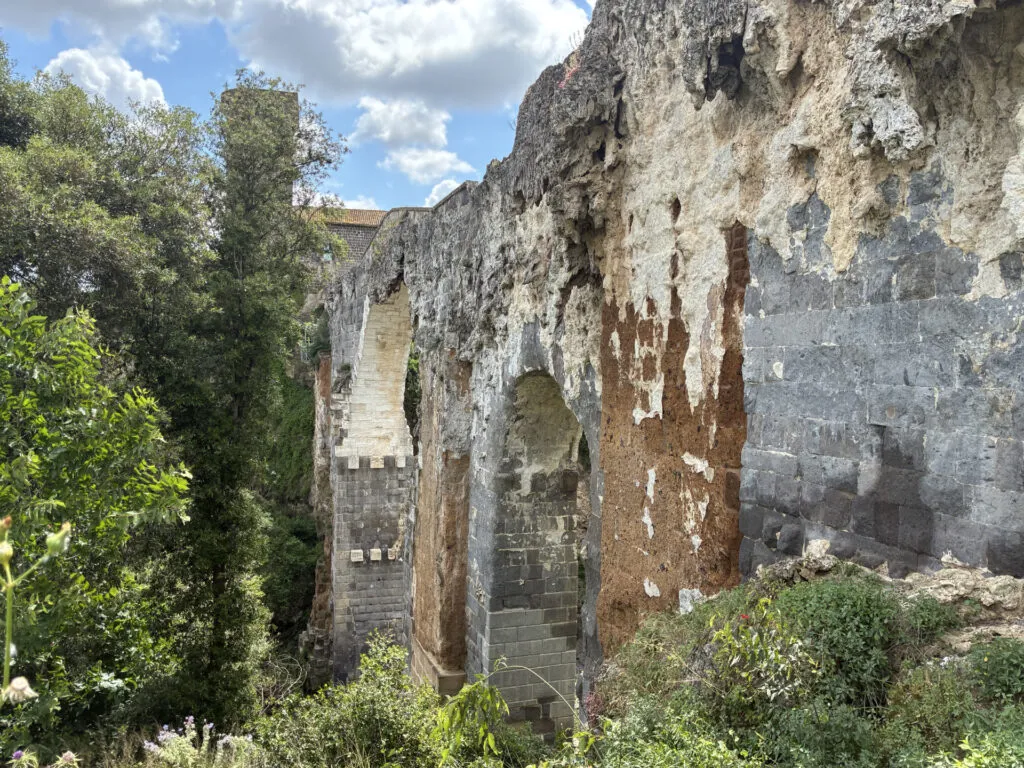
As can be seen from the image, there is definitely a Roman-era level, made of marble. And levels of restoration by the Romans.
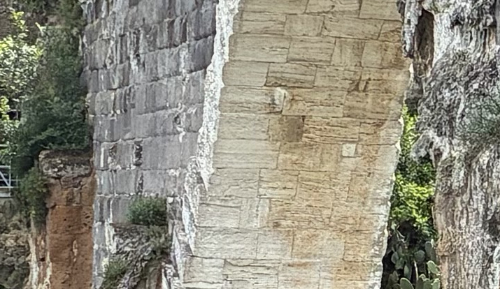
The first element encountered is consistent with what one would expect: a Roman marble arch and right behind it what is probably the reconstruction by the Romans using dark volcanic stone. Notice the regularity of the blocks.
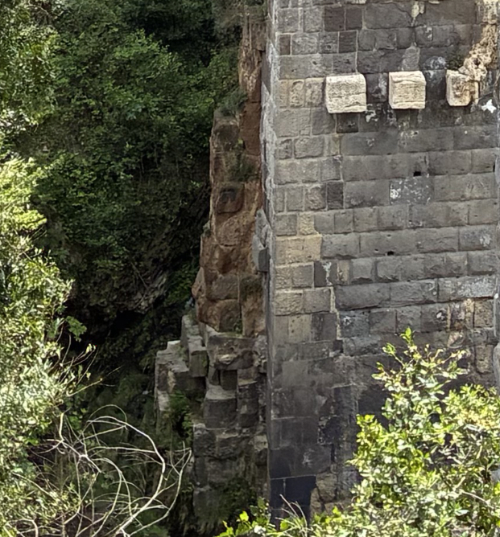
Further down one can glimpse the older work, made by the Etruscans. This is where the eye accustomed to observing the megalithic works of antiquity begins to notice something. What is the Etruscan tuff resting on? As we know, at successive cultural levels corresponds a temporal stratification that rises from bottom to top.
Below the Etruscan tuff (600-500 BC) we notice relatively large stones cut in a characteristic way: they are well cut, because they fit well together in terms of surface, but have the typical irregular shape of megaliths and polygonal architecture of the past.
Further curiosities continue moving toward the beginning of the bridge, observing it before crossing, facing the castle, on its outer part.
What does the type of stone cutting seen to the right of the tuff, at the bottom of this photo have to do with the ancient Romans? It is almost certainly a Roman restoration, since the stones are held together by mortar, but once again the more experienced eye will unmistakably notice stones not attributable to the ancient Romans.
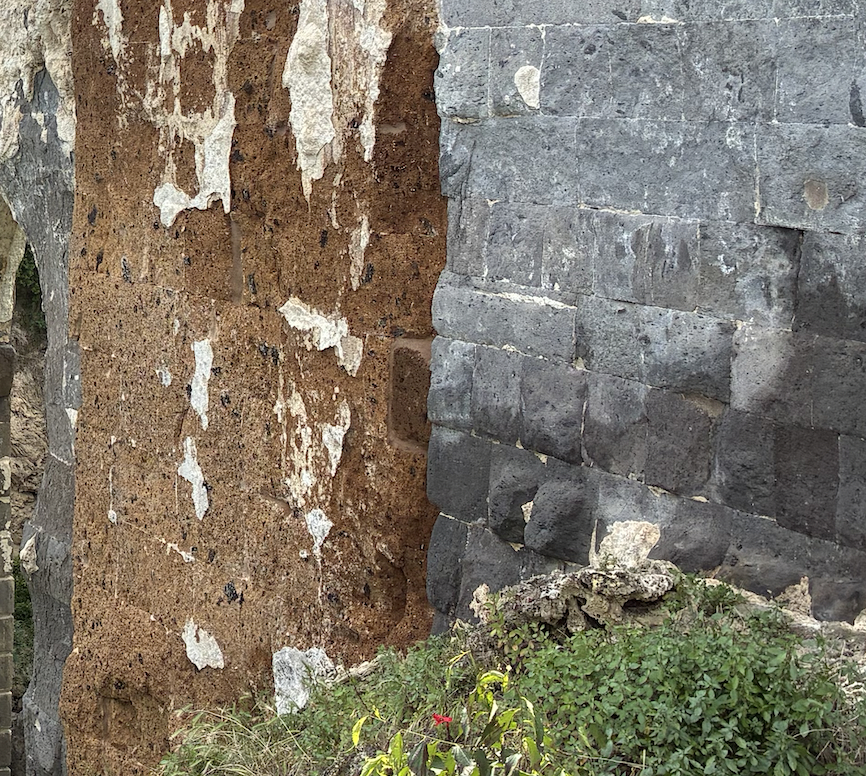

The stones used by the Romans for the restoration seem as if they were already part of the older Etruscan work, and perhaps were subsequently assembled more solidly by them. Immediately above the row of dark lava stone visible in the photo, one can see other stones perfectly consistent with the style of the ancient Romans.
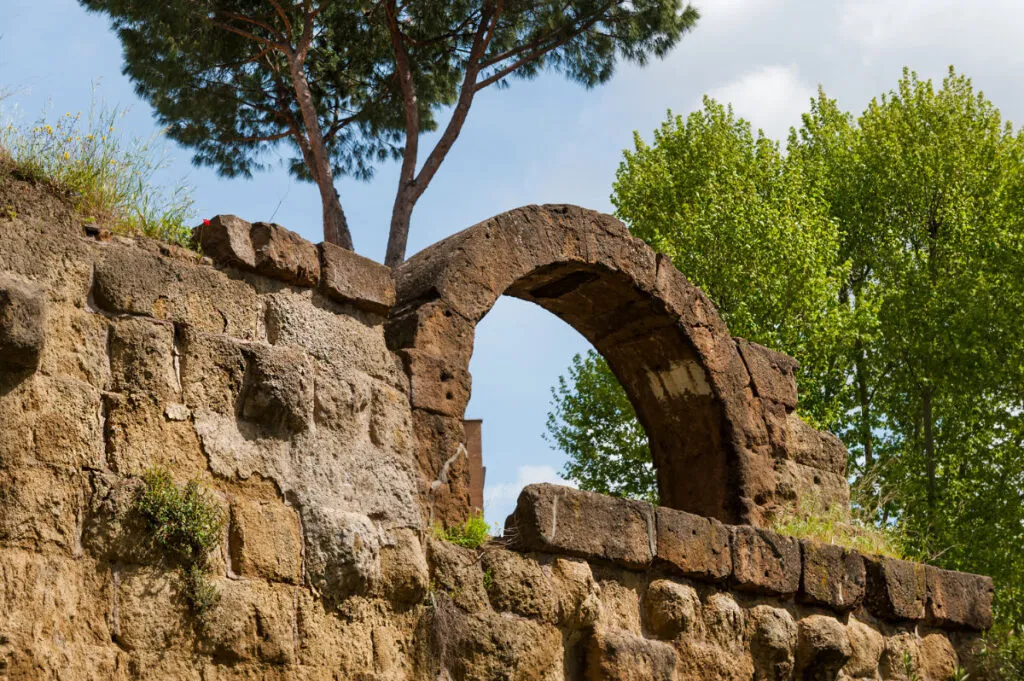
For an inexperienced eye it would be really difficult to follow the argument. For this reason, the base of the so-called Pyramid of Mycerinus in Giza is shown, and below it an Etruscan wall inside the city of Rome.
In the following image one can observe the typical Etruscan style which, as can be seen, features protuberances. Protuberances not in line with the style of the ancient Romans and instead found precisely on some parts of the dark lava stone of the Ponte dell’Abbadia.
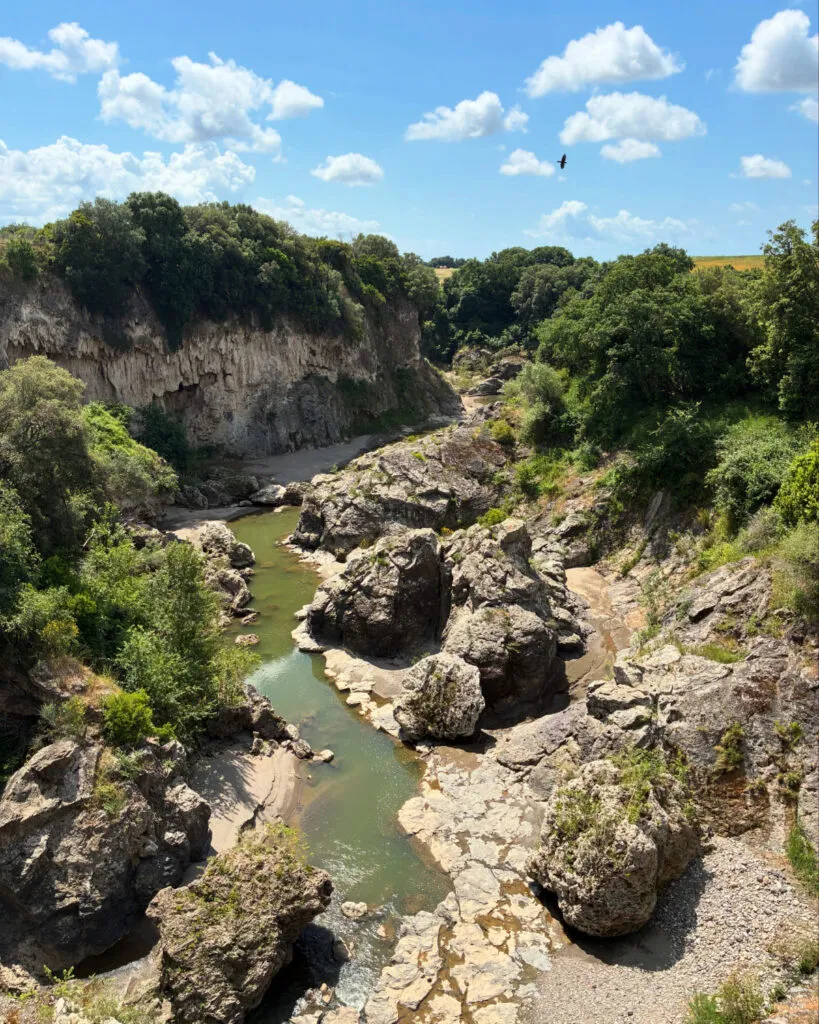
To date, it is believed that the only surviving Etruscan part of the bridge is the tuff, and even if this is the case it does not detract from the magnificence of the people with mysterious origins. The image shows the view from above the Ponte dell’Abbadia, which suggests the complexity of building a structure from bottom to top to such a height.
Yet, observing the bridge with more attentive eyes used to examining ancient polygonal megalithic works and the protuberances on stones found worldwide, from Central America to Japan, but especially in Turkey – possible origin of the Etruscans – it unmistakably stands out a touch foreign to the Romans, even on part of the darker lava stone (much harder than tuff). The Romans, some centuries later, might have “simply” rebuilt a work originally far more complete than we can imagine today.
The hypothesis we would like to bring to light is the possibility that some cultural elements and construction skills of works present between Lazio and Tuscany attributed to the Romans could be Etruscan or at least originate from them.