
This article examines the possible connection between the Etruscans - a people who played a key role in the founding of Rome - and Turkey, Troy, and Atlantis.
The Etruscans are a fascinating and mysterious people, from their very origins, and they also played an important role in the founding and early stages of the Roman Empire.
Also called the Tyrrhenians, Herodotus was the first to mention them in the 5th century BC, within his Histories. Herodotus tells that Atys, son of Manes, had to deal with a famine in Lydia that lasted for years, eventually forcing the population to reduce its numbers. He decided to split them into two, entrusting his son Tyrsenus with the part of the people that would have to find their fortune elsewhere.
Thus, the people of Lydia (or rather, half of them) led by Tyrsenus, arrived “near the Umbrians” and settled in those lands until at least the time of Herodotus, according to his accounts. They took the name from the leader who brought them to safety, becoming from that day the Tyrrhenians.
We can infer that by “near the Umbrians,” Herodotus likely meant those peoples located between Tuscany and Lazio on the map of Italy.

The symbol of the swastika found among the ruins of Troy in the late 1800s by Heinrich Schliemann suggests that the origins of the peoples of Lazio and Tuscany, linked to the myth of Aeneas and the Trojan War, could have historical foundations.

After the fall of Troy, the hero Aeneas, son of Anchises and Venus, flees with his father and his son Ascanius, guided by fate in search of a new homeland. He lands in Lazio, where King Latinus ruled. An oracle had predicted that Latinus’s daughter, Lavinia, would marry a foreigner, not the local prince Turnus.
Aeneas asks for peace and Lavinia’s hand. Although Latinus agrees, Turnus opposes and declares war. After fierce battles, Aeneas kills Turnus in a duel and founds the city of Lavinium, named after Lavinia. From Aeneas’ son Ascanius will descend the lineage that will found Rome.
The Etruscans, like the inhabitants of Troy, used the swastika, which for them symbolized the eternal movement of the sun, the cycle of the seasons, good fortune, and cosmic energy. It was a sacred and protective symbol, different from the symbol that was tragically and wrongfully appropriated in the early 1900s, often depicted as decoration on ceramics, tombs, weapons, and ritual objects.
When the German archaeologist Heinrich Schliemann went to Ithaca, Greece, in 1868, he had one main goal: to discover the ancient city of Troy using Homer’s Iliad. […] Schliemann discovered his epic city – and came across the swastika – on the Aegean coast of Turkey. […] Schliemann had found Troy – and the remains of civilizations that preceded and followed it. And on fragments of pottery and other artifacts, he identified at least 1,800 variants of the same symbol.
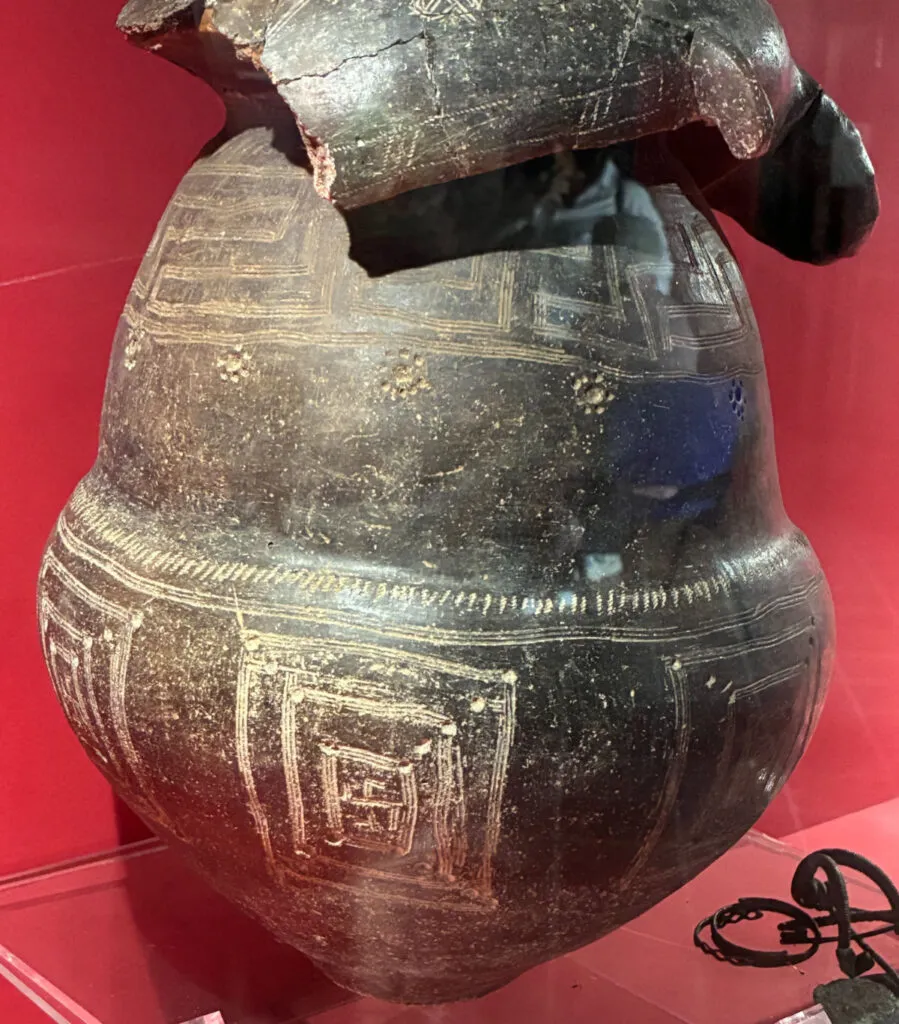
Engraving of a swastika on an Etruscan vase preserved at Vulci, Abbadia Castle.
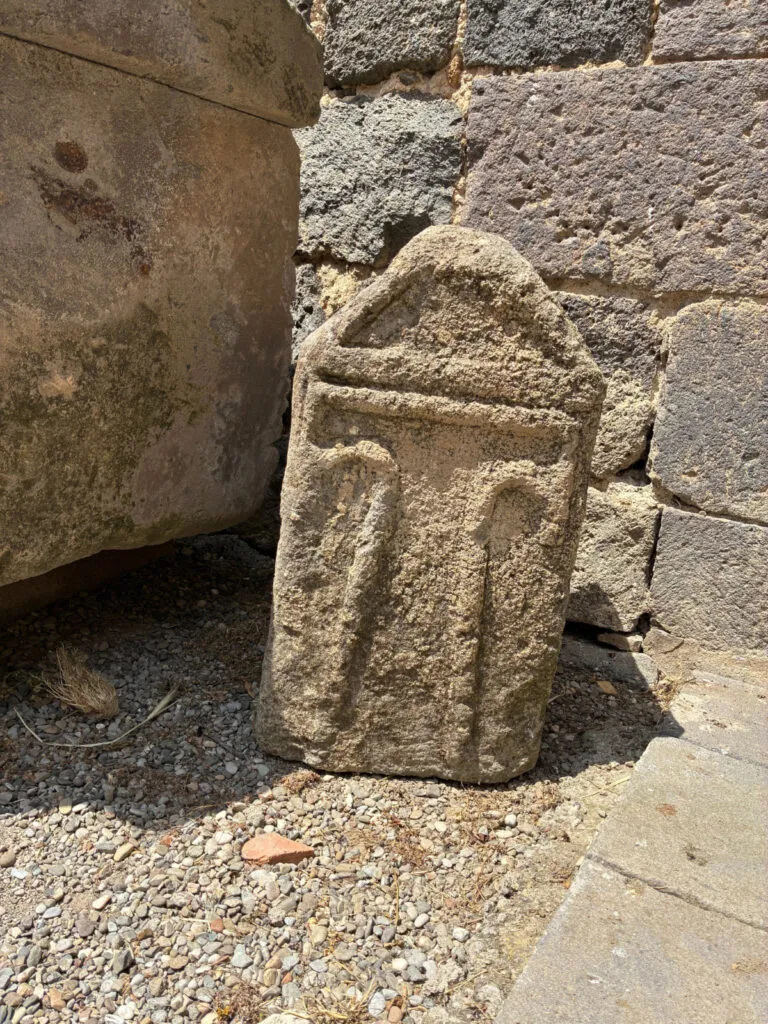
This T-shaped symbol was used by the Etruscans at Vulci.
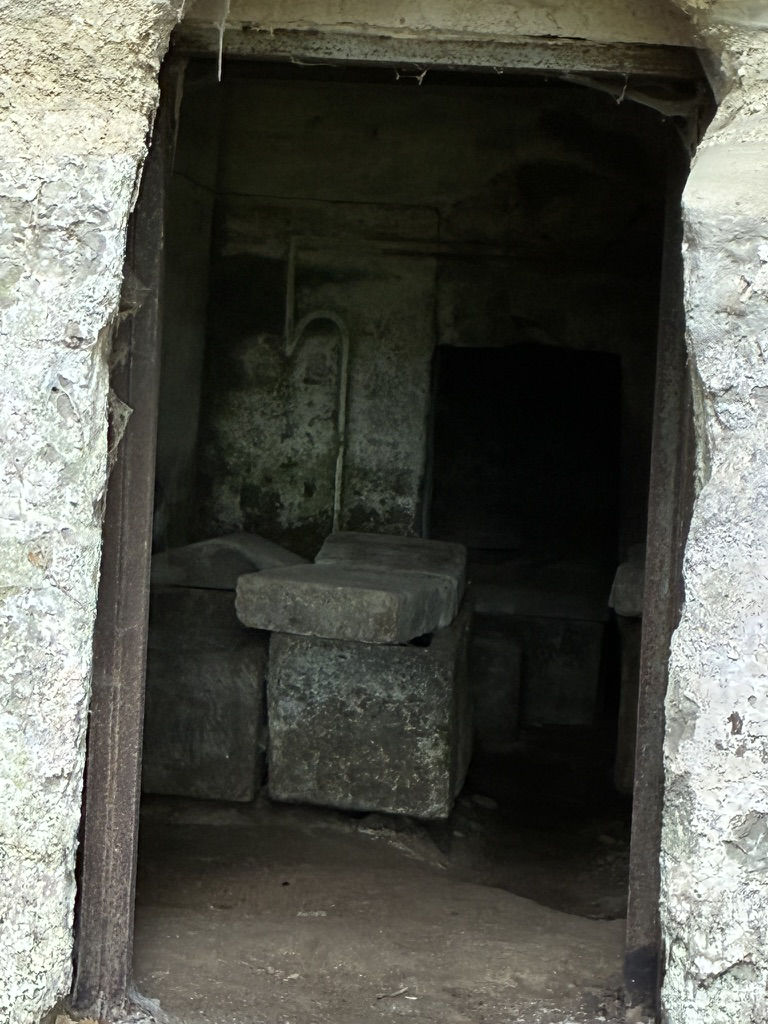
The symbol represents a path to the afterlife or generally a portal to another world, as evident in this photo taken (photo dated May 18, 2025).
The first thing that comes to mind is the T-shaped pillars of Göbekli Tepe. We might have a possible connection between Turkey and the Etruscans – a connection, as mentioned, also confirmed by Herodotus. It’s intriguing to think that maybe the peoples who made the famous T-shaped pillars at Göbekli Tepe are somehow related to all this. But for now, it remains a fascinating hypothesis.
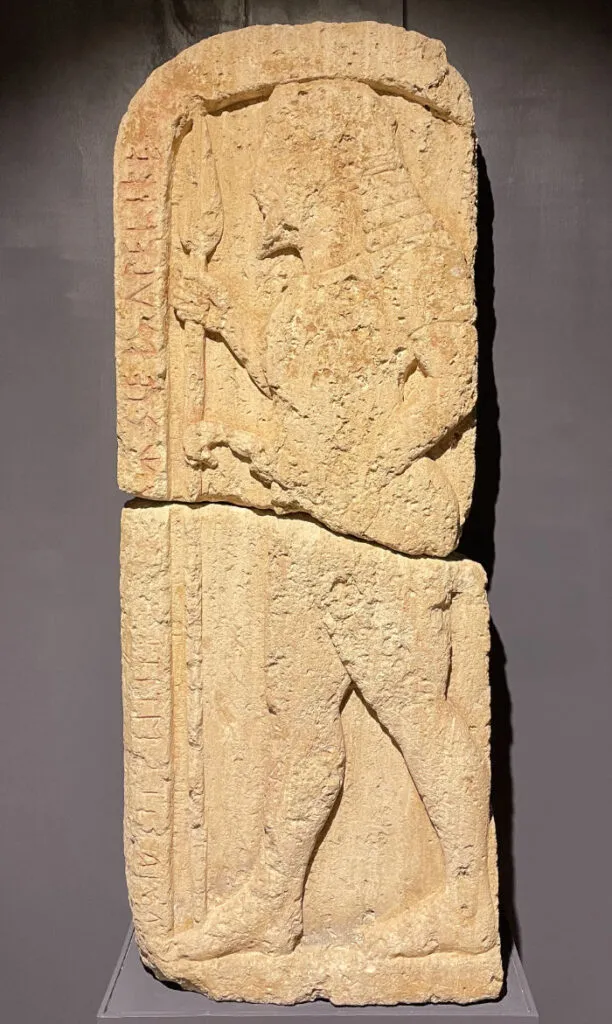
At the Etruscan Museum of Volterra, there is a depiction that closely resembles representations of ancient heroes from the Sumerian-Akkadian culture.
Another piece of the puzzle connecting the clues that lead us from Sumer, through Turkey and then Troy, all the way to the Etruscan civilization.
Another interesting element of the Etruscans is the elongated shape of the head found in some individuals, which in many cultures represents royal and divine ancestry. This shape is present in the remains of human skulls in some Etruscan museums, whose labels mention an artificially induced elongation of the skull of that particular individual [I saw it in person in Tuscany, and I have photos that I do not publish out of respect for the museum’s property rights; they are always placed somewhat hidden, probably to avoid exotic theories – Jack].
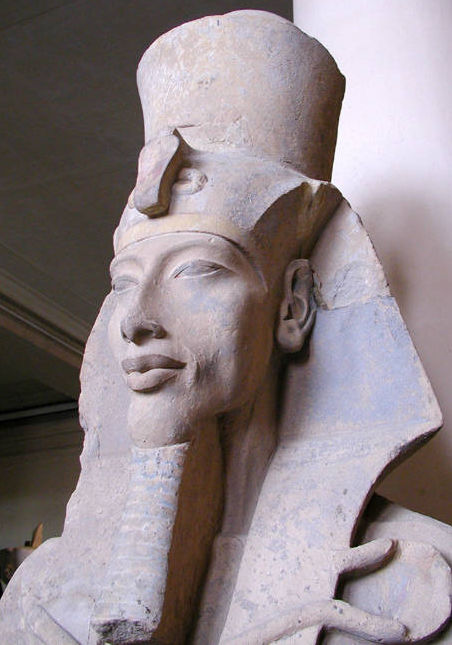
Also interesting is the shape of the eyes that emerges from statues and paintings depicting the Etruscans, almost as if it were a natural trait, which the Egyptians represented with special facial cosmetics, but which we find for example in a famous statue of the Egyptian ruler Akhenaten.
The elongated skull mentioned earlier is also found in ancient Egypt and is associated with nobility and divine descent: in a famous bust of Nefertiti, as well as in the presence of headdresses with very elongated shapes. Such headdresses date back to the time of the Sumerians.
Statue of Akhenaten from the Karnak Temple – Author Jon Bodsworth – copyright here
Etruscans, Pelasgians, and Atlantis
Another historical narrator, Hellanicus, identifies the Etruscans with the Pelasgians, another people of mysterious origin about whom we know little.
It’s reasonable to assume that the Etruscans likely descended from multiple peoples, but two mythological elements make them even more fascinating: the journey of Aeneas after the fall of Troy, which brought him to those very Tyrrhenian coasts, and the account in Plato’s Timaeus, narrated by Critias, Plato’s uncle. [I would like to thank Massimiliano Caranzano, of whom I suggest you explore books and seminars on his website, for pointing out this possible connection between the Etruscans and the mythical Atlantis—clearly referenced by Plato—during an email exchange – Jack.]
Through a chain of retellings, Critias learns a story that had been told to Solon by a priest of Sais, who, while referring to the legendary Atlantis, claims that its colonies once extended all the way to Tyrrhenia—namely, Etruria.
A people with a splendid culture, as well as refined and envied artists, who strangely struggled to narrate their own history or generally to use writing. Writing, just like number writing, seems to have come to them somewhat reluctantly from the Greeks and Romans. An example is the presence of the Beta and Delta characters in their alphabet, which were hardly ever used. The only forms of writing, or almost, were telegraphic words regarding the deceased or property, so much so that today we still cannot understand their language, even though we know the characters.
Does this remind you of something? Evidently yes, the Great Pyramid of Giza has no inscriptions inside. And the megalithic civilizations that left no explicit traces of their culture and that we are still struggling to reconstruct, for example, those preceding the Incas in Mesoamerica, left nothing written. This, however inconceivable it may seem, seems to find continuity with the Etruscans, at least in terms of nature. However, unlike the ancient megalithic peoples – to be fair – they had a form of artistic expression, clear and distinctive. While the peoples we refer to seemed to have an architectural form that was exclusively functional, whatever functionality they had in mind for their works. Almost as if it were forbidden for them to write, to exaggerate the reasoning with absurd logic, as hypothesized – in a science fiction context, of course – in the movie Stargate, where the “deity” Ra forbade it severely for fear of knowledge and awareness being passed on, which would have led to revolts of many against the few.
Just as we have the 12
So, Etruria within its nation – which as mentioned extended approximately from northern Lazio to Tuscany – had 12 important cities. More than important, they were considered of divine right.
We do not know for certain the names of all the cities of the Etruscan Dodecapolis, but according to scholars, they were probably: Arezzo, Cerveteri, Tarquinia, Volterra, Chiusi, Cortona, Perugia, Populonia, Vulci, Volsinii (identified with present-day Orvieto), Veio, and Vetulonia.
Some modern authors substitute Populonia with Volsinii, but Volsinii is explicitly mentioned by historical sources such as Titus Livius (Livy) and Pliny the Elder. The latter also mentions Roselle, although it was not part of the archaic Dodecapolis.
The Fanum Voltumnae was the spiritual and political heart of the Etruscan nation, where assemblies of representatives from the twelve cities were held, votes, religious ceremonies, and perhaps even military celebrations. It is mentioned by Titus Livius, and modern excavations in the Campo della Fiera area, near Orvieto, have uncovered cultic structures compatible with a large federal sanctuary.
What does this reference to the number 12 emphasize: most likely, the traces of the importance attributed to this number can guide us in connecting ancient peoples in a way we today overlook. This doesn’t necessarily mean that the earth was inhabited by people with 12 fingers, as there is no evidence of this, but perhaps they knew very advanced mathematical approaches, who knows from which civilization and time in antiquity. Reasoning based on 12 facilitates and enables trigonometric calculations, and realizing what is reported in the Plimpton 322 Tablet, begins to open up new paths.
[Thanks to Bjorn for the insight – Jack]
The base-12 system has ancient origins. You can count up to 12 using just one hand, by using your thumb to point to the phalanges of the other fingers: count up to 5 by raising your fingers; then add 4 by folding them all except the thumb, reaching 9; then use the thumb to touch the three phalanges of the index, middle, and ring fingers, reaching 12. The 5 fingers of the other hand can be used to keep track of dozens, allowing you to count up to 60.
This method was used in India and Mesopotamia, and spread across Asia, the Middle East, and Africa. The number 12 is divisible by 2, 3, 4, and 6, unlike 10 which is divisible only by 2 and 5 (both are of course divisible by themselves). This is believed to be one of the reasons why 12 became a foundation for many ancient systems, including those for measuring time and angles.
In conclusion, the political system of the Etruscans was oligarchic and aristocratic, with two main social classes, similar to the Patricians and Plebeians of the Romans.
A substantial difference between the Etruscans and the Romans/Greeks was the role of women, who were fully integrated into society, both in terms of leisure and public and private importance. They even played a role in politics, and this seems to place the Etruscans at a higher level than the entire culture that extends from the Sumerians to the Greeks and Romans, possibly hinting at an origin – at least partially – elsewhere.
The traces of the Etruscans have deep roots in myth and history. The versions by Virgil and Herodotus of a people originating, at least in part, from Turkey find tangible evidence in the presence of incredibly consistent symbolism between the peoples of Troy and Etruria: particularly through the symbol of the swastika. There is also a curious resemblance between the shape of the T-shaped pillars of Göbekli Tepe, also in Turkey, and the Etruscan T-symbol representing a passage to another world.
Another element placing the origins of the Etruscan people toward the Middle East is their somatic traits; observing the famous Tomb of the Lovers, as well as many other depictions, one notices a particular feature of elongated eyes, more similar to the peoples found moving further East of Italy. This somatic characteristic is also found in some Egyptian pharaohs such as Akhenaten, who culturally also seem to descend from peoples of the Middle East. Consider the countless amount of symbolism in ancient Egypt, very similar to that of the Sumerian-Akkadian peoples.
The magnificence of the Etruscans particularly inspired ancient authors; for example, Plato defined them as a true colony of Atlantis, on par with other lands of the Mediterranean and Egypt.
The presence of the number 12 within a context of great sacredness to them further places the Etruscans within a perimeter to study and deepen, given the presence of this number in the most important cultural traces of our past.
In conclusion, all this is enriched by a social structure based on equality between men and women, who had equal rights to participate in politics and social events.