
Perugia was located along the border between the Etruscan and Umbrian worlds, with the first settlements dating back to the 10th century BC. The urban structure is heavily Etruscan, as evidenced by the mighty city walls still visible.
The strategic position along the Tiber River favored the city’s development, which became one of the twelve lucumonies of the Etruscan confederation.
Polygonal cut on the stones of the Etruscan Arch in Perugia
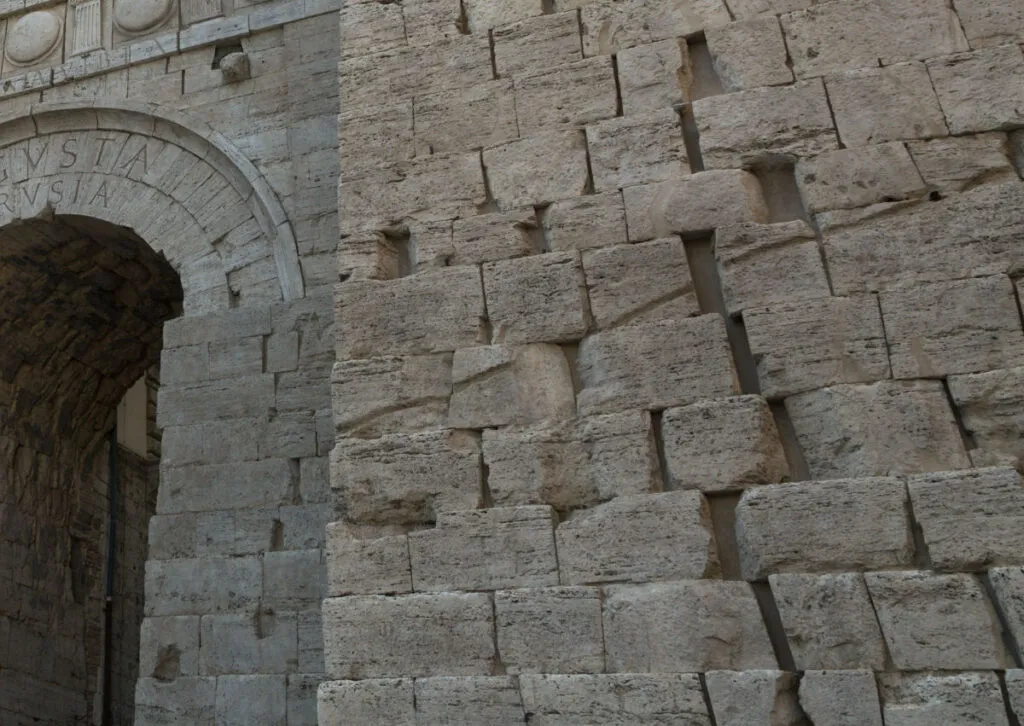
Known also as the Arch of Augustus, the Etruscan Arch is the most impressive and best-preserved of the seven gates of the Etruscan walls of Perugia. Built in the second half of the 4th century BC, it was restored in 40 BC at Augustus’ request following his victory in the conflict known as the Battle of Perugia.
Also known as the Arch of Augustus, the Etruscan Arch is the most imposing and best-preserved of the seven gates of the Etruscan walls of Perugia.
After the Battle of Sentino (295 BC), Perugia came under Roman influence, maintaining its Etruscan language and identity for a long time.
In the Middle Ages, Perugia assumed a central role in Tuscany. Conquered by the Ostrogoths and later the Byzantines, it gradually entered the Papal territories, while maintaining strong autonomy.