
Over 100 new structures discovered at Gran Pajatén (Peru) thanks to LiDAR surveys and advanced technologies, further mapping civilizations in Peru before the Incas.
A team of researchers led by the World Monuments Fund (WMF) announced one of the most important archaeological discoveries in recent decades in the San Martín region, in northeastern Peru.
More than 100 new archaeological structures have been found at the site of Gran Pajatén, located in the Río Abiseo National Park – a UNESCO World Heritage Site. This discovery is particularly significant as until now only 26 structures had been documented during research carried out until the 1980s.
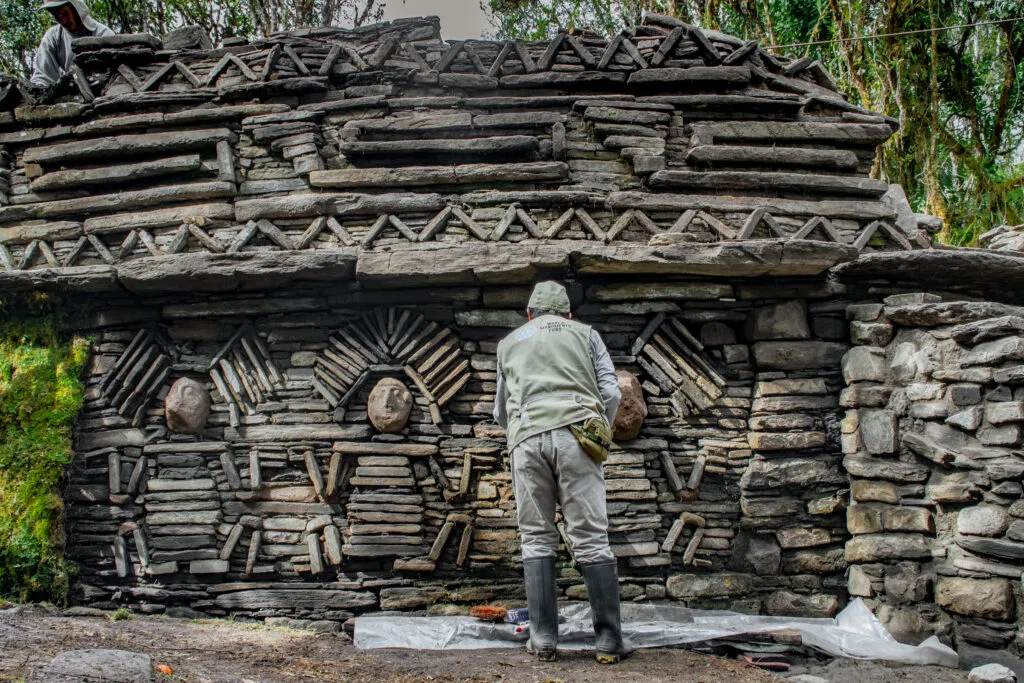
Photo: conservation work on the North Basing of Building 1 in Pajatén, Peru. Photo by Heinz Plenge Pardo.
This discovery represents a breakthrough in understanding the Chachapoya civilization, known as the “people of the cloud forest,” who lived between the 7th and 16th centuries on the Andean highlands at elevations between 2,000 and 3,000 meters (6,561 and 9,842 feet). The Chachapoya developed complex settlements including ceremonial buildings, agricultural terraces, and cliffside burial sites often in remote and rugged environments.
Although they initially resisted Inca expansion, they were incorporated into the empire in the late 15th century, shortly before the arrival of the Spanish.
Discovered in the 1960s, Gran Pajatén is known for its ceremonial buildings decorated with stone mosaics, high-reliefs, and views over the surrounding forest. However, much of the site remained hidden beneath dense vegetation, and its true extent and function were unknown.
Between 2022 and 2024, WMF undertook a multidisciplinary advanced exploration campaign. Thanks to technologies such as LiDAR, photogrammetry, technomorphological analysis, and topographic surveys, archaeologists were able to precisely map the entire complex without disturbing the park’s fragile ecosystem.
This discovery revolutionizes our understanding of Gran Pajatén and places it within an articulated network of interconnected pre-Hispanic settlements.
Juan Pablo de la Puente Brunke, Executive Director of WMF Peru.
Recent investigations have confirmed occupation of the site dating back at least to the 14th century, also providing clues of earlier habitation. Additionally, a network of pre-Hispanic roads connecting Gran Pajatén with other regional sites such as La Playa, Papayas, and Los Pinchudos emerged, suggesting a structured and widely developed territory.
Alongside mapping, the team began conservation interventions on one of the main buildings of the complex, including structural consolidation, joint refilling, reinforcement of stairs and carved reliefs, as well as partial reconstruction of the perimeter wall. All work was done using a compatible clay-based mixture, designed to respect the site’s authenticity.
This intervention constitutes a pioneering model for future conservation operations in the area.
Dr. Ricardo Morales Gamarra, head of the conservation project.