
Remains of Ptolemaic and Roman Fortresses Unearthed at Tell Abu Seifa in Sinai: Military Housing and Industrial Structures Enrich the History of Ancient Egypt's Eastern Defenses.
During ongoing excavations at the site of Tell Abu Seifa in the northern Sinai archaeological zone, military fortifications, soldier accommodations, and a moat have been unearthed. The moat may indicate the presence of a third, yet unidentified fortress. The discovery was reported by the Egyptian Ministry of Tourism and Antiquities.
The discovery is also of great significance because it further helps to understand Egypt’s eastern defense systems during the Ptolemaic and Roman periods.
The Ptolemaic period in Egypt lasted from 305 BCE to 30 BCE.
After the end of the Ptolemaic dynasty, Egypt became a province of the Roman Empire in 30 BCE and remained under Roman control until the division of the Roman Empire in 395 CE, when it came under the rule of the Byzantine Empire.
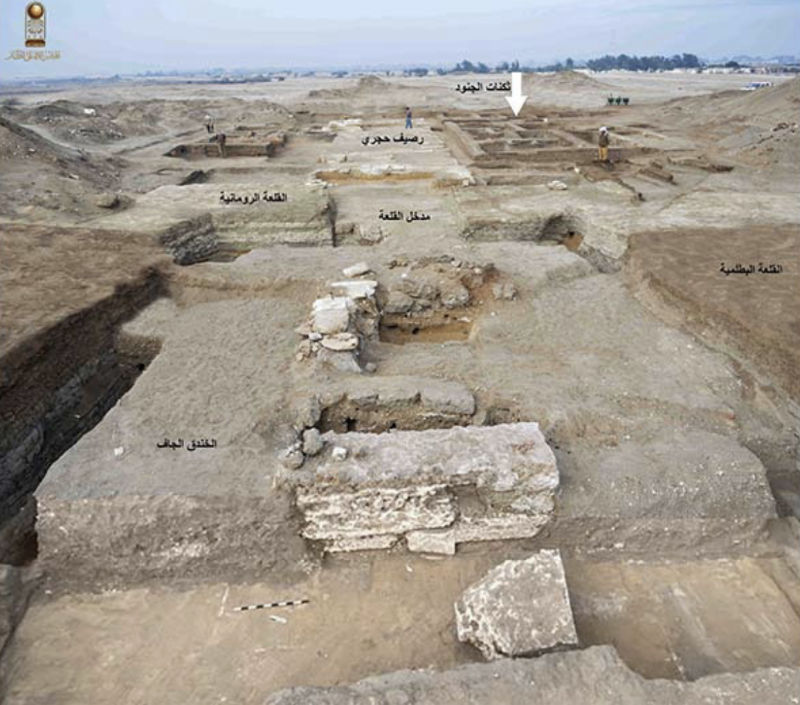
During the mission, a massive structure connected to the two eastern gates of the fortress, previously discovered, was found. In addition, a defensive moat more than two meters deep (over 6.5 feet) was identified at the entrance of the fortress. A discovered road — 11 meters wide (36 feet) and over 100 meters long (328 feet) — finally reveals a connection between the older structure dating back to the Ptolemaic era and the Roman one.
Along the sides of the road, more than 500 circular clay cavities were found, likely used to hold ornamental trees decorating the entrance of the fortress during the Ptolemaic period. Dwellings for Roman-era soldiers were also unearthed, along with four large kilns used to produce quicklime, likely marking the Roman transition during which the structure became an industrial site.
The discoveries reinforce the evidence that the Tell Abu Seifa site, strategic for the defense of eastern Egypt, gained increasing importance over time, especially after the change in the Nile’s course and the retreat of the coastline, which shifted the strategic center from Tell Heboua (ancient Tharu) to Tell Abu Seifa.