
Porta San Sebastiano is the largest and one of the best-preserved gates in the Aurelian Walls of Rome. It was originally called Porta Appia because the urban stretch of the Via Appia began here, and it wasn’t until the 15th century that it took its current name, due to its proximity to the basilica and catacombs of Saint Sebastian.
The structure dates back to the 3rd century AD but was heavily modified during the reign of Honorius (401–402), who reduced the entrances to a single passage and added an attic with two rows of windows, battlements, and a walkway for guards. Later on, the gate was further raised and expanded, assuming its current appearance. The definitive attribution of these works remains uncertain.
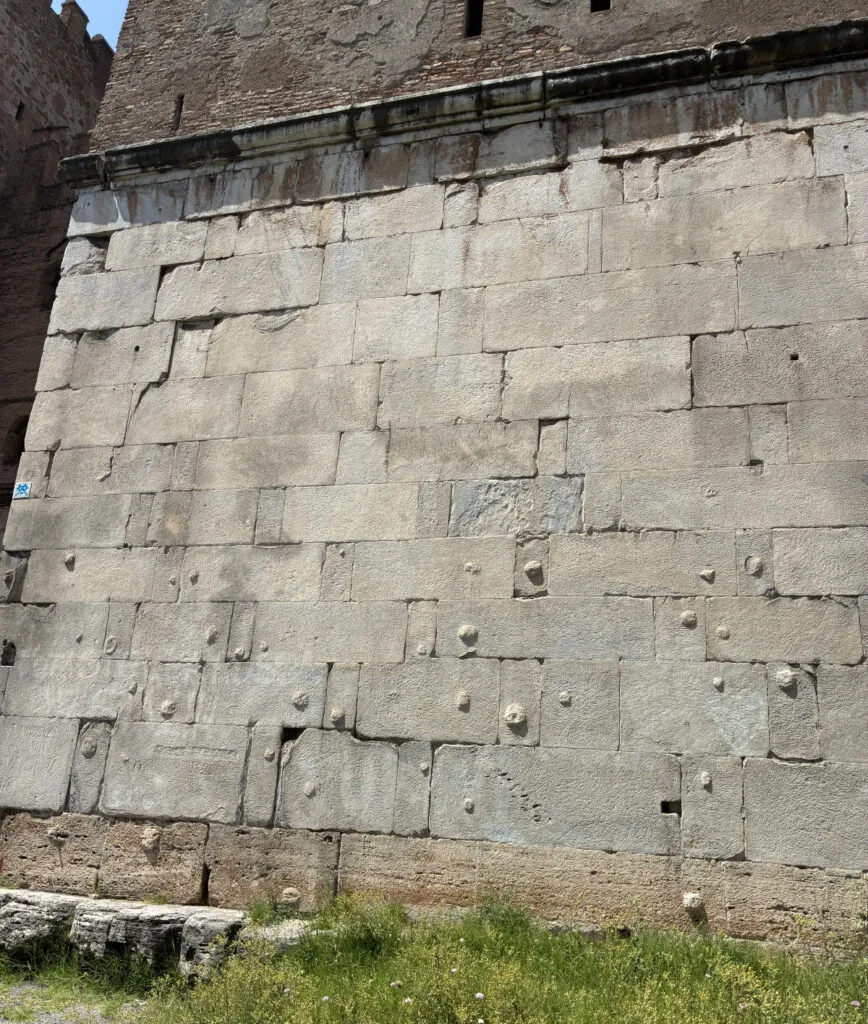
The image shows the mysterious protrusions on the masonry, found in many ancient cultures across the world. No logical explanation has been established, as the current paradigm does not account for the possibility of ancient contact between some of the peoples who made them.
Once equipped with wooden doors and a portcullis, the gate still preserves traces of its original defensive structures. On the sides, carvings and symbols recount centuries of passage, conflict, and pilgrimage: crosses, votive inscriptions, names, dates, and graffiti overlap as testimonies of its long daily life. On the right jamb, there is a relief of the Archangel Michael slaying a dragon, next to a 1327 inscription commemorating a Ghibelline victory over Angevin troops.
In 1536, for the triumphal entry of Charles V, the gate was temporarily transformed into a celebratory arch. It was also crossed by the procession of the victor of Lepanto, Marcantonio Colonna, in 1571, with Turkish prisoners in chains.
In the Middle Ages, like other city gates, it was entrusted to private individuals for the collection of tolls, according to regulated rates.
Today, it houses the Museum of the Walls, which illustrates the history and evolution of Rome’s defensive system.