
Recent studies have shown that the cat from Cyprus was not domesticated, thus pointing to ancient Egypt, around 3,000 years ago, as the origin of the cat domestication process.
Recent studies from the University of Exeter and the University of Tor Vergata in Rome, reported in this article from Archeology News Online Magazine, place the process of cat domestication in Egypt and not in Cyprus as previously thought. The two studies concluded that the famous Cyprus cat was a European wildcat, not domesticated. Specifically, the University of Exeter reached this conclusion, which was later confirmed by nuclear DNA analysis from the University of Tor Vergata.
To trace the origin of the domestic cat, we must go to Egypt 3,000 years ago (approximately 1000 BCE), and not Cyprus as previously thought.
The remains of the Cyprus cat were discovered in 2001 and belonged to a European wildcat.
The domestication is thought to have occurred for religious reasons, particularly for the worship of the goddess Bastet and not for agricultural reasons. This is another very important point to consider, as it is often said that the reason was “functional” to protect crops, for example, from animals that could damage them.
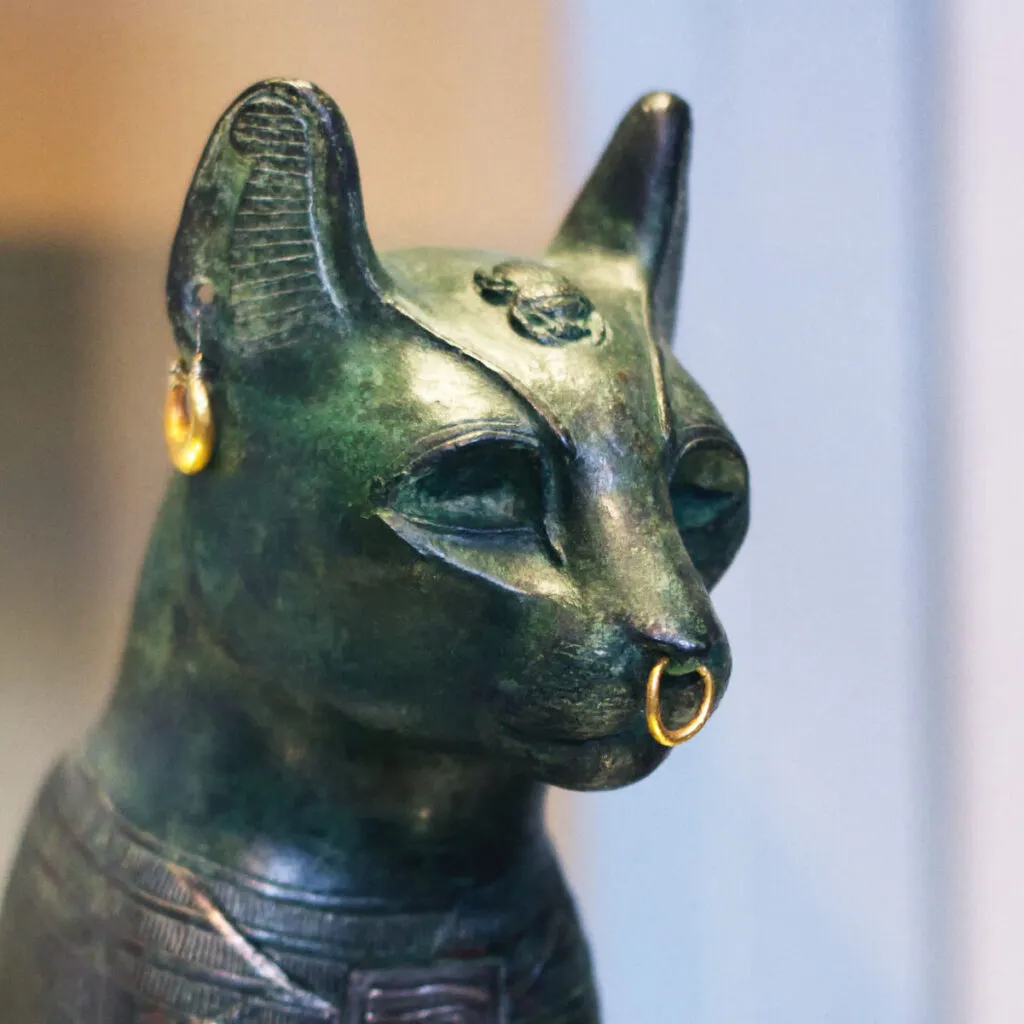
We know that Bastet was worshiped since the Second Dynasty (2890 BCE) and was initially called Bast, later known also as Baast, Ubaste, Baset, and by the Greeks as Ailuros.
Originally, she was a goddess of war in the Lower Egypt, represented as a lioness or a woman with a lion’s head. After the unification, her role changed, and from a fierce goddess of war, she became a protective deity associated with cats, women, fertility, and childbirth.
During the New Kingdom, the name became Bastet with the addition of the feminine suffix -et.
Especially due to this common origin in the form of a lioness, Bastet should not be confused with Sekhmet, whom we could say is the gentler and more protective counterpart. Or perhaps became such over time, as if it followed in some way the domestication (softening in her case) of the cat we are discussing.
Despite this cultic origin, the crops greatly benefited. The temples were located near agricultural regions infested with rodents, and the closeness between humans and cats provided significant social benefit to the Egyptians.
Modern domestic cats descend from Felis lybica lybica, a subspecies of the African wildcat. Two migration waves, starting in the 1st millennium BCE, led to the global spread of the domesticated species.
Domestication was not linear nor solely agricultural, but influenced by various cultural and religious factors across North Africa. Scientists are calling for further genetic studies on North African wildcats to better clarify the domestication process.