
The Roman Forum is a true gem in Rome, visited by thousands of people every day. Beyond its undeniable beauty and historical importance, it is also intriguing for those seeking more ancient traces, as we do in Lost World Map, especially with two highly relevant points: the Temple of the Dioscuri and a location near the Temple of Romulus, as we will see further down in this page dedicated to the site.
Originally, the area was a marshy valley located between the Palatine and the Capitoline Hills. By the end of the 7th century BC, following major drainage works — including the construction of the Cloaca Maxima, traditionally attributed to the Etruscan kings — the space began to be transformed into a true urban center.
During the Republican era, buildings for political assemblies and religious cults were erected in the Roman Forum, along with commercial structures. In the 2nd century BC, civil basilicas were built, such as the Basilica Aemilia and the Basilica Julia, where judicial and administrative activities took place.
With the rise of the Empire, the monumental character of the site increased: temples were erected in memory of deified emperors, such as the Temple of Vespasian and Titus or the one dedicated to Antoninus and Faustina. The last major construction was the Basilica of Maxentius in the early 4th century AD.
In the following centuries, the area was gradually abandoned, buried, and turned into pastureland. It came to be known as the Campo Vaccino (“Cow Field”).
Archaic traces and Etruscan influence

In the oldest part of the Forum there are tuff blocks and foundations built using Etruscan techniques, such as in the Mamertine Prison, the tuff pavement of the Lacus Curtius, or in the earliest phases of the Via Sacra.
This is why this entry is also tagged with Etruria. It is a very important site for getting a little closer to understanding the ancient, mysterious civilization that mostly lived between Tuscany and Lazio.
The image shows a layer above the Etruscan-style architecture which likely once had additional blocks resting atop it, preserving its condition and showing what must have been the incredible finishing of the structure when it was newly completed.

Traces of architecture older than the Romans

Temple of the Dioscuri: on the right, a protrusion. As we know, this is a very ancient symbol, as described in the section dedicated to protrusions. It’s curious that it appears on a structure tied to the mythological figures of Castor and Pollux, on the temple dedicated to them.

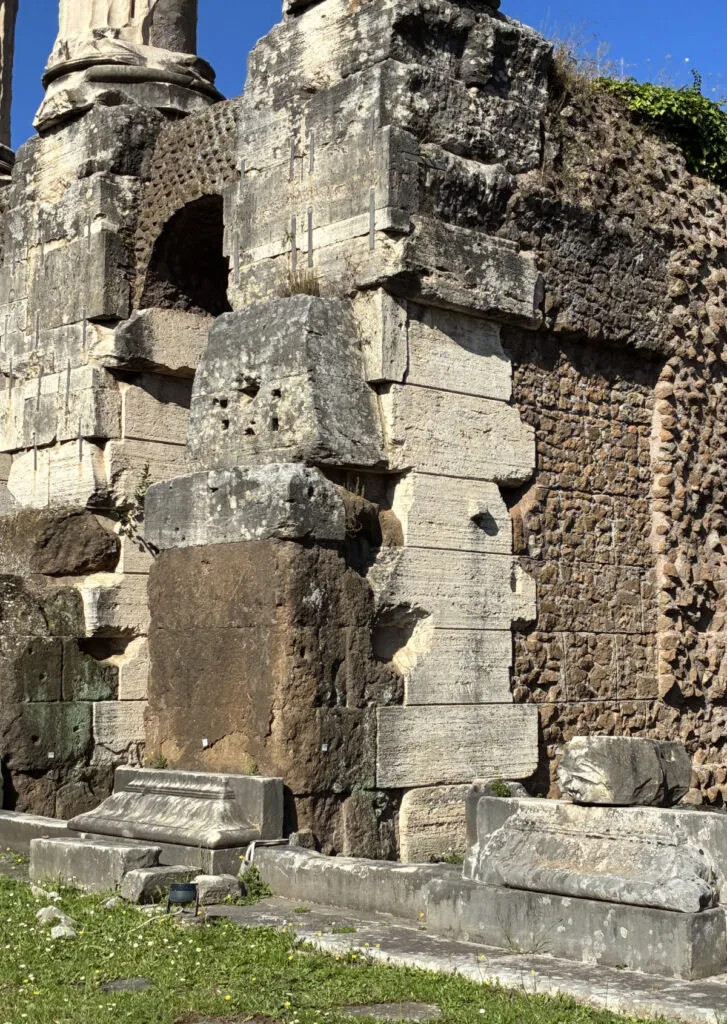
Close-up of the Temple of the Dioscuri, where a protrusion can be seen.
How to reach the two locations
The two points where protrusions (or nubs) can be seen in the Roman Forum. One of them also features a reference to polygonal architecture.
- Point 1: Easy to spot; it is located at the Temple of the Dioscuri.
- Point 2: More hidden, but easily reachable by following this direction: pass the Temple of Romulus keeping it to your left, then turn left and continue straight.