
Analysis of the structures and hypotheses on the original functions of the underground city in Cappadocia: advanced engineering, communal spaces, and unresolved mysteries, possibly linked to the Recent Dryas.
In this article, we analyze in more detail the characteristics of the Derinkuyu site, striving to stay grounded while highlighting particular or unexplained elements.
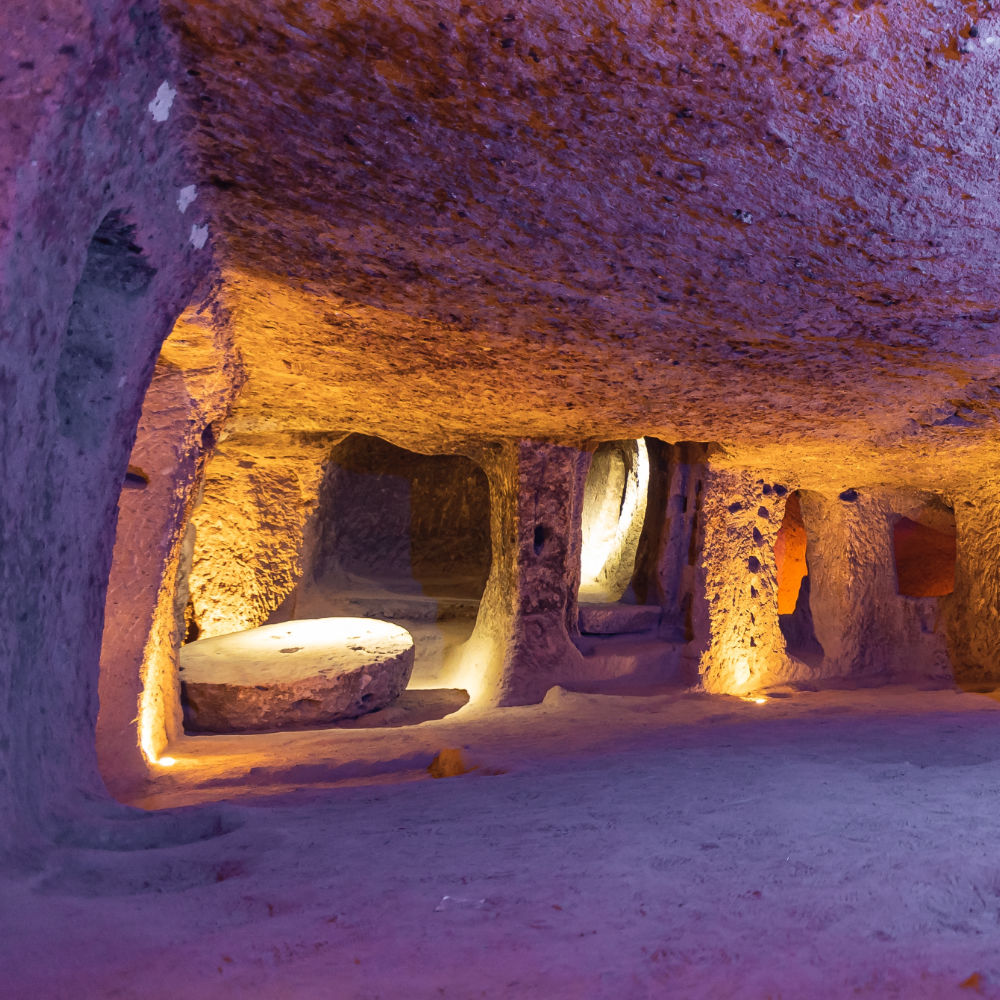
Derinkuyu is the largest underground city dug in Turkey, 85 meters (279 feet) deep and capable of housing up to 20,000 people with animals and food supplies.
The site has surprising characteristics that are worth analyzing, to try to provide answers or, without forcing it, keep them in mind while waiting for further clues.
Let’s now analyze clues and evidence, and at least ask some interesting questions about Derinkuyu.
The entrances could have been closed from the inside with large rolling stone doors: this gives us some first clues. What for?
Each level could have been isolated separately, which corresponds to two main hypotheses, plus a third additional one.
Here we begin to delve into truly fascinating aspects, let’s make a comparison with today’s world to start. If two countries were at war, one would tend to protect itself with the whole population – assuming it had a sufficiently large bunker, inside a bunker? The answer is categorically: no. Control in battle should also be over the surface territory, and in the bunker, only a few important figures would be sheltered in very critical situations. Bringing all necessary supplies for living, including animals, proves that the entire population took refuge underground. In a scenario where the few are compared to the many, the many could provide the few with provisions periodically. The few could go out periodically to restock, and then return to shelter.
So everyone took refuge down there: why?
Let’s make some reasonable hypotheses here as well, assuming that those who dug that place – in that way – were intelligent. Intelligence that we tend to attribute only to post-1900 times far too often.
The third hypothesis, which seems the most plausible, however, implies a dating earlier than that of the Phrygians, the people currently hypothesized to have built it. But this shouldn’t surprise us, since it was later reused by Greeks, Arabs, Mongols, and Turks.
Additionally, as evidence of the importance of staying sheltered underground, the city is connected – among others – to an underground city called Kaymakli, via an 8-9 km tunnel (5-5.6 miles).
The myth links this place to a sort of Noah’s Ark, similar to the biblical one and not far from the locations where it would have taken place. With different elements though: in this case, the deity supposedly suggested that the people dig and take refuge underground. Let’s remember that such an extreme defensive action might correspond to natural events different from those related to heavy rains and floods, which would have drowned all the inhabitants of the underground city. It would be more likely to move the timeline towards a natural phenomenon of a meteoritic origin or something linked to fire rather than water.
During the period of the Younger Dryas, two catastrophic events are referenced, occurring around 13,000 and 11,000 years ago. Some scholars hypothesize that the first event was caused mainly by meteoritic impacts and fires, while the second was characterized primarily by floods and rising sea levels. The second event could align with what Plato transmitted in the “myth” of Atlantis.
Another exceptional clue to help orient conclusions: they found time, in all this, to create a room dedicated to passing on their culture, the most important thing for a civilization, synonymous with survival.
To make survival possible, a ventilation shaft was created, an impressive 55 meters (180 feet) long, demonstrating true engineering knowledge.
Let’s try to imagine, in conclusion, the construction methods of the site, built through subtractive architecture, very common in ancient times and similar to, for example, the works of the Etruscans and Sardinians.
Imagine these people who had to dig down 85 meters (279 feet), creating many rooms along the way. Think about the dust that could have suffocated the workers. Let’s stop and think about the lighting, both during the excavation and when 20,000 people lived there. Do we really want to believe it was possible to keep torches burning, which would have caused smoke?
Derinkuyu, with its extraordinary complexity, continues to raise questions. The site’s characteristics, such as the rolling stone doors, the isolated levels, and the presence of spaces for daily life, suggest it was a refuge designed to protect a large population from catastrophic events. The hypotheses about meteoritic impacts and climate change, related to the Younger Dryas, seem plausible. However, questions remain about how these people anticipated such events and how they dealt with practical difficulties in construction and daily life. Derinkuyu remains a fascinating mystery awaiting new answers.