
Sant Odile is a charming place atop an imposing mountain, overlooking Strasbourg, and located on the border between France and Germany.
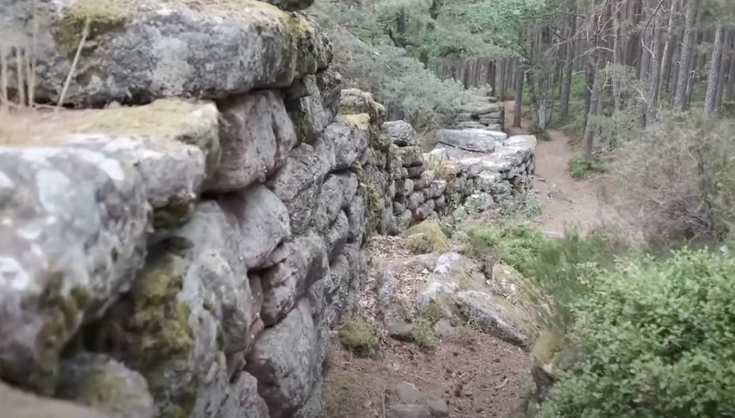
Surrounding it are imposing stone walls, apparently built with the characteristic polygonal architecture, without mortar to hold the parts together.
A feature found worldwide, and present at the walls of Saint Odile, is that they were not placed to defend an internal structure.
The walls, as if to distinguish them from what was evidently built later inside them, were called Heiden-mauer “Walls of the Pagans”. We are thus facing yet another case of more recent structures placed within enormous fortifications that are older.
One of the most interesting aspects of the walls of Saint Odile are the traces of the so-called clamps, dovetail-like elements that held the stone parts together.
These elements are found worldwide and suggest the possibility of a very ancient, globally interconnected culture, whose traces have been lost. They have been found, for example, in Bolivia, Egypt, Cambodia, and many other places.
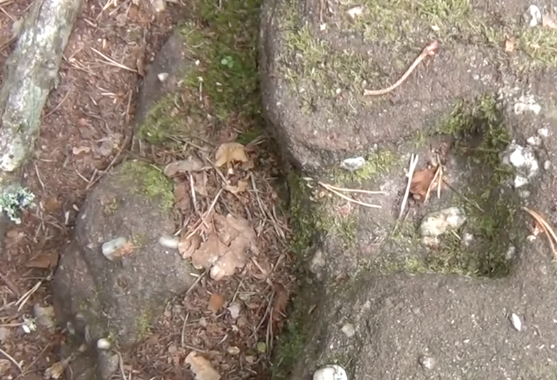
Unlike polygonal walls worldwide, whose true purpose remains unknown, the so-called clamps can be explained as something logical, simple, and economical, and therefore could be designed and made by anyone, even by cultures not directly connected.
Furthermore, at Saint Odile, evidence shows that the clamps were made of wood and not metal, as in other parts of the world.
The use of clamps is also incompatible with polygonal architecture, precisely because by definition, polygonal architecture aims to prevent the stone parts from sliding against each other. This places Saint Odile outside the context of ancient cyclopean architecture.