
Located in Lebanon and declared a UNESCO World Heritage Site in 1984, Baalbek boasts some of the most fascinating ancient ruins in history. The site contains megaliths so impressive that they raise many questions about how they were made and transported.
Sometimes, we tend to think that we can take something we know how to do and scale it to greater heights simply by increasing the time we dedicate to it, the people working on it, and the amount of material used, but this is not the case, and Baalbek is there to remind us of that.
Its ruins are generally attributed to the Romans or Greeks, but it is important to distinguish the foundations from the structures built above them. The Roman Temple of Jupiter, for instance, rests in Baalbek on megalithic foundations, which are far from the architectural style of the Romans. Moreover, the Romans were accustomed to venerating the site, with recurring visits that, for some reason, led them to those lands.
The Baal (the lord) worshipped at Baalbek was most likely Hadad, the Canaanite god of storm and fertility, often referred to simply as Baal (“lord”). When we think of ancient civilizations, we tend to view them in isolated compartments, yet here we have another example of a significant connection. For the Romans, in fact, this deity corresponded to Jupiter, and they likely built their temple over pre-existing foundations. This makes sense, especially considering that the Roman Empire had never constructed megaliths of such magnitude-even in the heart of its own capital.
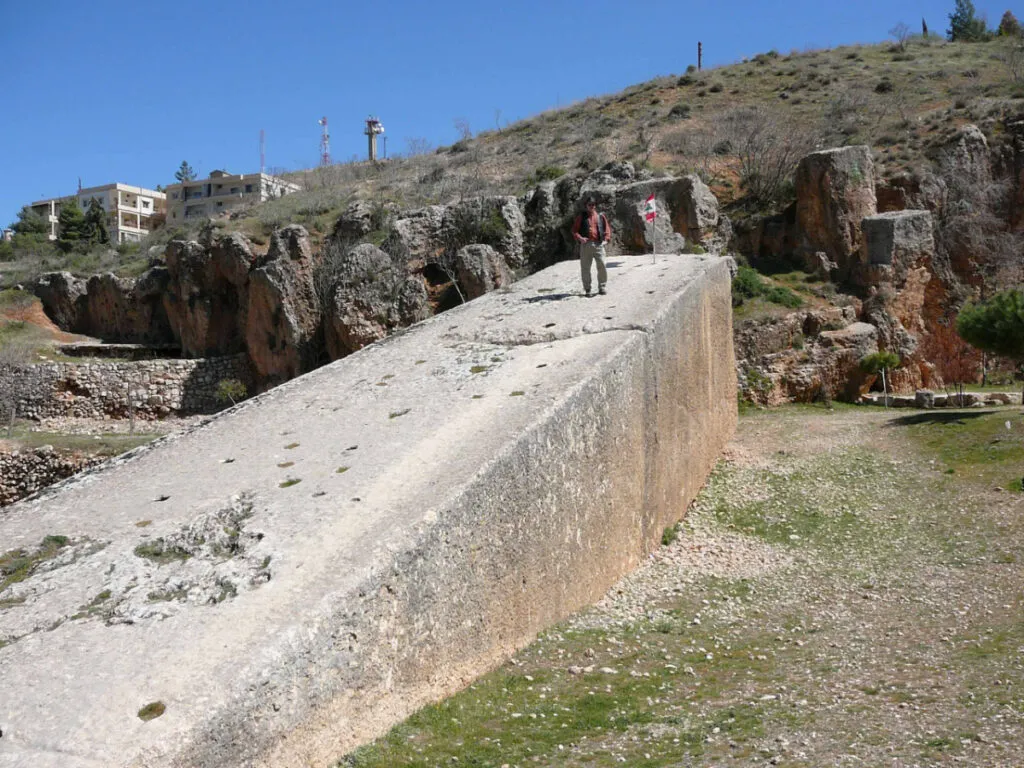
The so-called South Stone is estimated to weigh 1,200 tons (2,645,500 pounds), while some smaller stones range from 300 to 800 tons (661,400 to 1,763,700 pounds).
Ralph Ellis on the large stone at Baalbek, known as the Stone of the Pregnant Woman – CC BY-SA 4.0