
The archaeological site of Ġgantija hosts some of the oldest megalithic temples in the world, dated approximately between 3600 and 2800 BCE. Located on the Xagħra plateau on the island of Gozo, Malta, it is also known as the Temple of the Giants. This name derives from a local tradition claiming that only superhuman beings could have moved the colossal stone blocks used to build the structure. Listed as a UNESCO World Heritage Site in 1980, Ġgantija represents one of the most imposing and best-preserved testimonies of the entire Maltese megalithic culture. The complex offers valuable insights into the Neolithic societies of the Mediterranean, their relationship with the landscape, fertility cults, and the evolution of early monumental architecture.
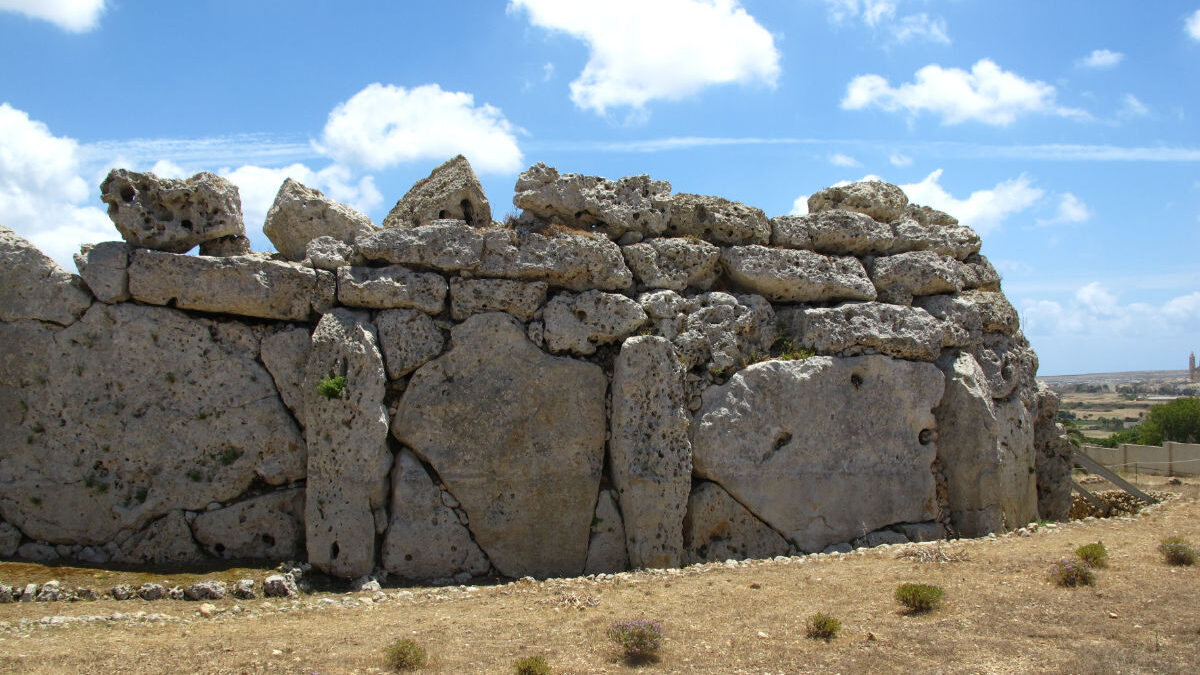
The structure is made of coralline limestone, used for the most resistant external parts, and globigerina limestone (a stone typical of Malta) for the interiors. One of the site’s distinctive features is its dry-stone masonry technique, typical of megalithic polygonal architecture found across the world. This technique requires not only a refined understanding of stone properties, but also advanced engineering skills for weight distribution and wall stability. The outer blocks — some exceeding five tons — were arranged to create an extremely solid and durable envelope, while the more delicate interiors used smaller worked stones to shape sacred spaces. The combination of such different materials reveals clear architectural intent and a high degree of specialization among Neolithic Maltese communities. Similar construction models appear in distant regions such as the Caucasus, Anatolia, and parts of the western Mediterranean, suggesting possible contacts or parallel architectural evolution.
The site is composed of two temples with separate entrances, sharing a common perimeter wall. The ground plan follows a cloverleaf (or trefoil) layout, with later expansions involving the larger temple, additional side chambers, the smaller temple, and the external courtyard. This layout, known as the “cloverleaf plan,” recurs in Maltese temples and may reflect complex ritual symbolism: the multiple niches may have defined distinct spaces for ceremonies, offerings, or processions. Archaeological excavations show that the main temple was enlarged several times over the centuries, demonstrating cultural continuity and the site’s importance to the island’s inhabitants. The internal arrangement suggests ritual pathways and a gradual progression toward increasingly sacred areas, similar to other megalithic complexes with religious functions. Some interior surfaces show signs of smoothing and occasional traces of red pigments, likely associated with symbolic themes of life, blood, or fertility — all central to Neolithic Maltese spirituality.
Precise Orientation
The site is oriented northwest and aligned along a NW–SE axis, a configuration recurring across the archipelago, with carefully designed solar illumination on specific dates. This orientation does not appear accidental: many Maltese temples show astronomical alignments linked to solstices and equinoxes, likely used to mark seasonal cycles, harvests, and agricultural activities. At Ġgantija, natural sunlight may have created symbolic effects during key rituals, illuminating niches or altars. Some researchers suggest that the temple was used for ceremonies connected to fertility, a theory reinforced by numerous female figurines discovered in coeval Maltese sites. Beyond astronomy, the location on the Xagħra plateau provides natural visibility over the surrounding landscape, indicating that the site also played territorial and social roles.
Findings and Ritual Evidence
Findings at the site reveal evidence of ritual fires, libation holes in the floor, and remains of animal bones, all pointing to collective rituals and ceremonial feasting. The main ceremonies took place outside the temples, in a large elevated courtyard. This open space allowed the participation of many individuals, highlighting the communal importance of the site. The animal bones — mainly from goats and pigs, species widely kept in Neolithic Malta — show marks of ritual slaughter. The floor holes, interpreted as libation points, indicate practices of pouring liquids such as water, milk, or fermented beverages as sacred offerings. Large flat slabs suggest the presence of altars used for votive deposits or ceremonial acts. Some small finds, including stone spheres or decorative objects, may have held symbolic meaning or been used in rituals that remain difficult to reconstruct in detail.
The analysis of megalithic sites worldwide reminds us of the need for great caution when interpreting organic material or other remains found at a specific location. Such traces may belong to later occupants rather than to the original builders. The reappropriation of ancient sites is a universal cultural phenomenon and entirely natural. In the case of Ġgantija, certain post-Neolithic traces confirm that the site continued to be frequented in later epochs, possibly as a territorial landmark or a place of local veneration. It is important to consider that Malta’s landscape has undergone major transformations over millennia — erosion, agriculture, construction, and climate variations may all have altered the site’s appearance. Modern interpretations must therefore consider material evidence alongside broader anthropological and comparative studies. Ongoing research continues to contextualize Ġgantija within Mediterranean networks, opening new perspectives on ancient navigation routes, cultural exchanges, and symbolic parallels among civilizations separated by both space and time.