
Tiya is located in the central region of Ethiopia, in the woreda of Soddo, Gurage zone, south of Addis Ababa.
The megaliths in Ethiopia are a very ancient tradition, with numerous examples that precede the Christian era.
The site was declared UNESCO World Heritage in 1980, due to the uniqueness of its monolithic monuments.
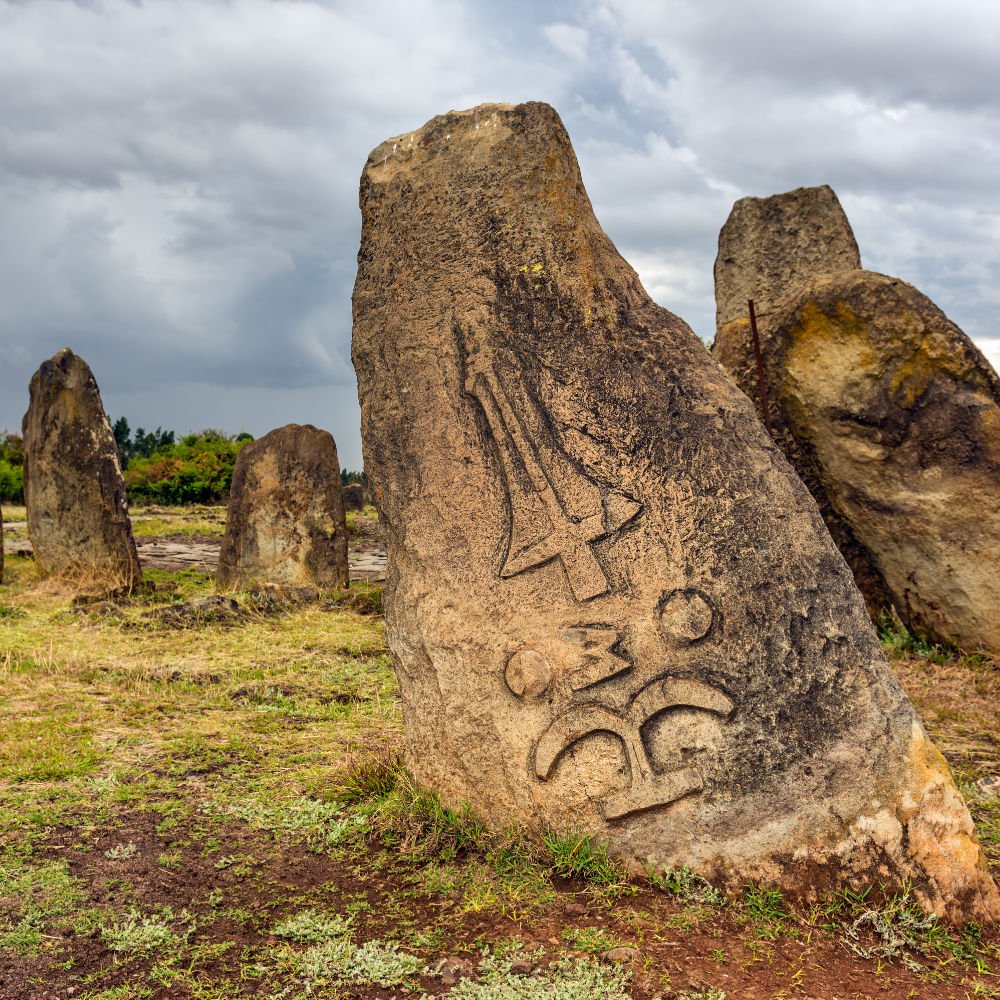
According to excavations by Joussaume (1995), the site dates from a period between the 11th and 13th centuries AD, although other datings place it between the 10th and 15th centuries AD.
UNESCO Documentation
You can access the UNESCO documentation regarding this site.
In general, the data provided is summarized as follows:
- Location: Soddo Region, Ethiopia
- Date of nomination: April 25, 1978
- ICOMOS recommendation: Inclusion of Tiya in the World Heritage List.
Justification for the nomination
- The Soddo region is rich in megalithic archaeological sites, including numerous carved monoliths.
- The most representative site is Tiya, which contains 36 stelae, some of which are arranged along an axis of 45 meters (148 feet). The stelae are monolithic in shape, such as hemispherical, conical, and anthropomorphic.
- Of these 36 stelae, 32 are decorated with symbolic motifs, some of which are difficult to interpret, but in some cases depict swords.
- The stelae have a funerary significance, as the tombs are located around them.
Criteria for inclusion in the World Heritage List
- Criterion 1: The stelae with their enigmatic configurations are unique cultural achievements.
- Criterion 4: The stelae are highly representative of the megalithic period in Ethiopia, an important historical period.
Conservation Status
- Tiya has been protected by the Administration of Antiquities since 1958. Recently [in 1980], archaeological studies were conducted on the sculptures of the stelae.
- Although the stelae are mostly in good condition, they are threatened by destruction due to their symbolic nature.