
The story of Göbekli Tepe (a UNESCO World Heritage Site since 2018) recalls a recurring phenomenon: we tend to underestimate – or even completely ignore – key pieces of our past, simply because they fall outside what we consider possible. In the specific case of Göbekli Tepe, the so-called “impossible” concerned the existence of a stable settlement, featuring an organized megalithic complex, a defined social structure, and the ability to store food resources. These elements indicate unexpected sedentism and social complexity for such a remote era.
Göbekli Tepe was discovered in modern times in 1963 by a Turkish-American research group who noticed flint fragments indicating human activity, but they mistakenly identified the site as a medieval cemetery. It was later rediscovered by a local shepherd in 1995, who noticed peculiar stones emerging from the ground. Excavations began that same year and were taken over by two German universities in 2006.
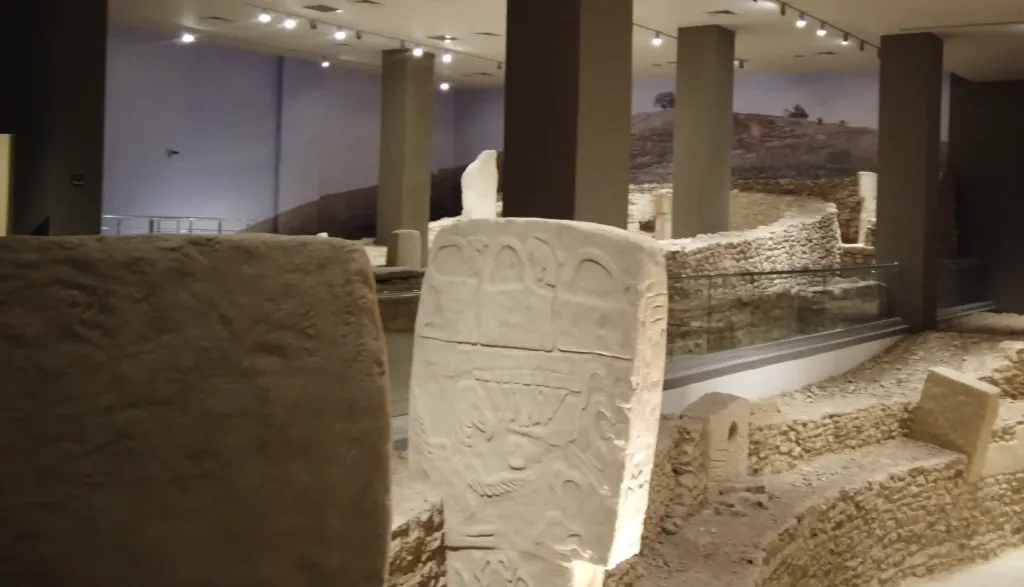
Klaus Schmidt, the German archaeologist who led the excavations from 1996 to 2014, referred to the anthropomorphic figures depicted on Göbekli Tepe’s T-shaped stones as the Watchers, evoking a concept strongly linked to the Sumerians and other ancient peoples.
Image taken from the video Exploring Megalithic Gobekli Tepe And Other Ancient Sites In Turkey by Brien Foerster – thanks for the permission granted
Incredible dating for Göbekli Tepe
As we know, the Sumerians inhabited the territory of present-day Iraq around 4000 BCE, about 6000 years ago. When we think of ancient Rome, we are recalling a people for whom the Sumerians had lived 4000 years earlier.
For the Sumerians, any memory of the Göbekli Tepe culture would have dated back 3000 years earlier—truly staggering numbers.
The dating of Göbekli Tepe seems to bring us close—perhaps very close—to a potential pre-Diluvian civilization, one that existed before a catastrophic event that is believed to have struck the planet around 12,800 years ago, at the end of a very cold period, according to an increasing number of converging sources—during the so-called Younger Dryas event.
We must consider that Göbekli Tepe is dated to 10,600 years ago based on organic remains found within only 5–10% of the site excavated so far. Let us explain: if someone today were inside the Great Pyramid of Giza and dropped some food, and shortly after a massive, almost instant catastrophe struck the planet, future archaeologists might try to date the Pyramid based on that food’s remains—incorrectly placing it in the year 2025. We must also remember that the interior of the Pyramid is completely devoid of inscriptions or depictions that might tell a different story.
So we understand that 10,600 years is a conservative estimate for Göbekli Tepe, a lower boundary. We also know the site was rapidly buried by its occupants, for reasons that remain unclear.
The site is also close to Karahan Tepe, another very ancient and mysterious location that could reveal surprising discoveries in the coming years, alongside Göbekli Tepe.
A possible cultural connection?
It’s important not to jump to hasty or unfounded conclusions; equally important is to note a possible cultural connection between ancient Turkey, Iraq and Egypt, kept alive despite the passing of hundreds and hundreds of years, and therefore presumably based on a story considered to be of great significance.
