
What is the Mohs scale, how it allows for comparing different materials, and an in-depth look at the temporal anomaly in stoneworking techniques.
The Mohs scale, created by mineralogist Friedrich Mohs in 1812, measures the hardness of materials using ten minerals, from talc (hardness 1) to diamond (hardness 10). Each mineral can scratch the one before it and is scratched by the one after it. The scale only provides an indication of hardness, without accounting for significant variations between adjacent minerals.
Minerals that make up the Mohs scale: The minerals Mohs used to create his scale are as follows:
On the left, we can read the level of hardness attributed by Mohs on the scale, from 1 to 10. On the right, the number refers to the absolute hardness, a crucial value for understanding the next part of this article. For now, it is enough to understand that if we say quartz has a hardness of 7, it doesn’t mean it is seven times harder than talc, but 100 times harder (based on the absolute hardness). The data is cited from Wikipedia, referencing Applied Mineralogy: Applications in Industry and Environment by Swapna Mukherjee.
Keeping in mind the Mohs scale and applying a logic of progressive civilization development, along with knowledge, skills, and capabilities, one would expect to find works of increasing complexity over the generations. One would never expect the creation of more majestic works to be abandoned in favor of more crude ones, since the advancement of knowledge and practice should correspond to a simplification of the analysis, design, and execution processes, thus ensuring at least the maintenance of quality.
Yet, in many parts of the world, we encounter the opposite situation, where we generally see recurring elements such as:
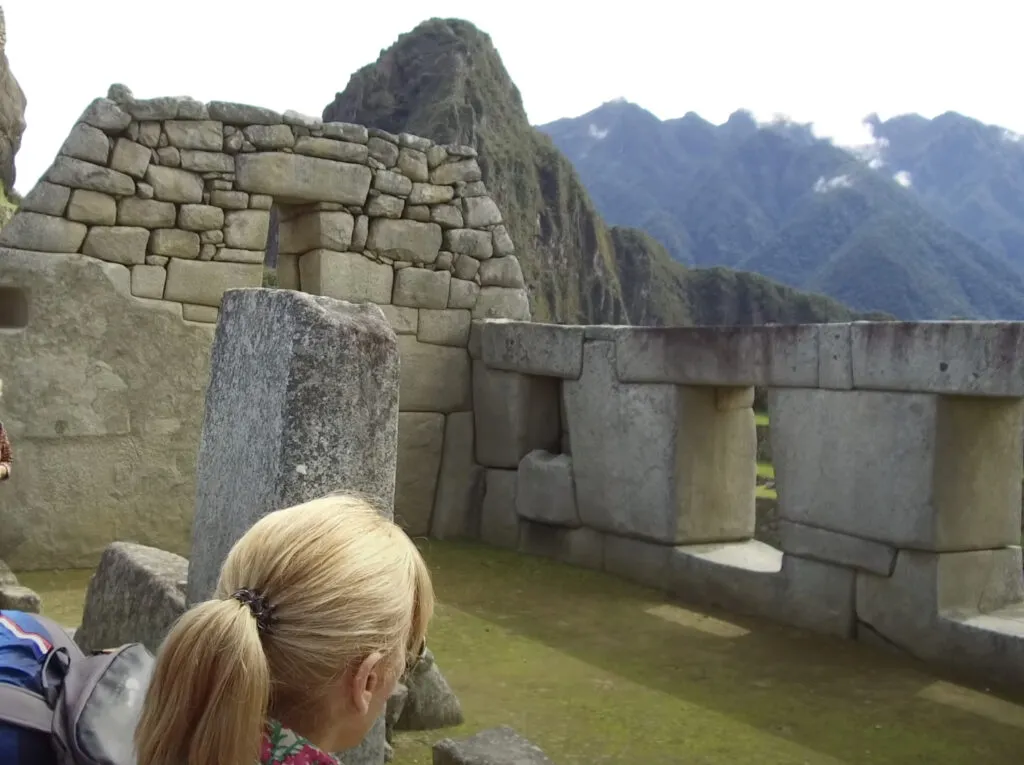
In the image above, we can clearly observe two different hands. The first, the oldest, capable of moving megalithic stones to the top of Machu Picchu, carving them in a three-dimensional polygonal interlocking pattern, without even the slightest gap today. In the upper part of the wall, the Incas added smaller stones that do not fit perfectly. Exactly what we would always expect to find from ancient civilizations.
Although it may seem like a forced hypothesis, there are now hundreds of hours of videos online where you can observe the work of these different hands—older than the more modern ones—in various parts of the world.
Image taken from the video Machu Picchu Majesty by Brien Foerster – thanks for the permission granted.
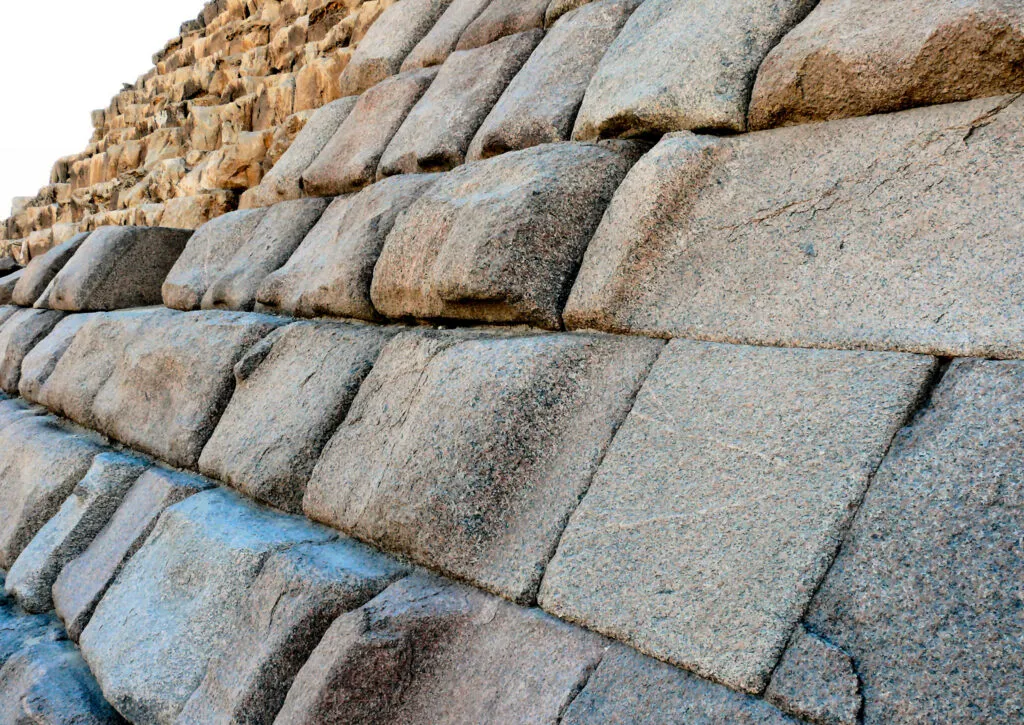
In the image, we see the base of the so-called Pyramid of Menkaure. The blocks we observe are made of pink granite and are placed above the softer stone, which we typically imagine was used to build the pyramids: the classic rectangular blocks. With granite, we are between 6 and 7 on the Mohs scale, yet we still attempt to accept that they were worked with copper. Consider what it means to believe that the Egyptians built—for example—the Third Pyramid of the Giza Plateau using only blocks of “soft stone,” and then add the complexity of granite to the task. This would multiply the hardness of the stone by 50. Also, we can notice the so-called protrusions or knobs, which are found all over the world. If we were to show, and this has been done, close-up shots from Egypt, Turkey, Central and South America, Japan, and many other countries, no one would be able to tell them apart. These protrusions are a feature that seems senseless to us, yet evidently— we must acknowledge— they are necessary and common to many civilizations.
Copper, the hardest metal available in ancient Egypt, has a hardness of about 3 on the Mohs scale, while granite, basalt, and diorite are between 6 and 7. Additionally, it’s important to consider that granite is made up of minerals with different hardness levels, including:
This means that by applying the appropriate force to its surface, even assuming the use of a sufficiently hard chisel or saw, it would be likely to encounter discrepancies and inaccuracies, if not actual breakages in the stone, due to the significant hardness differences among the minerals that make up granite.
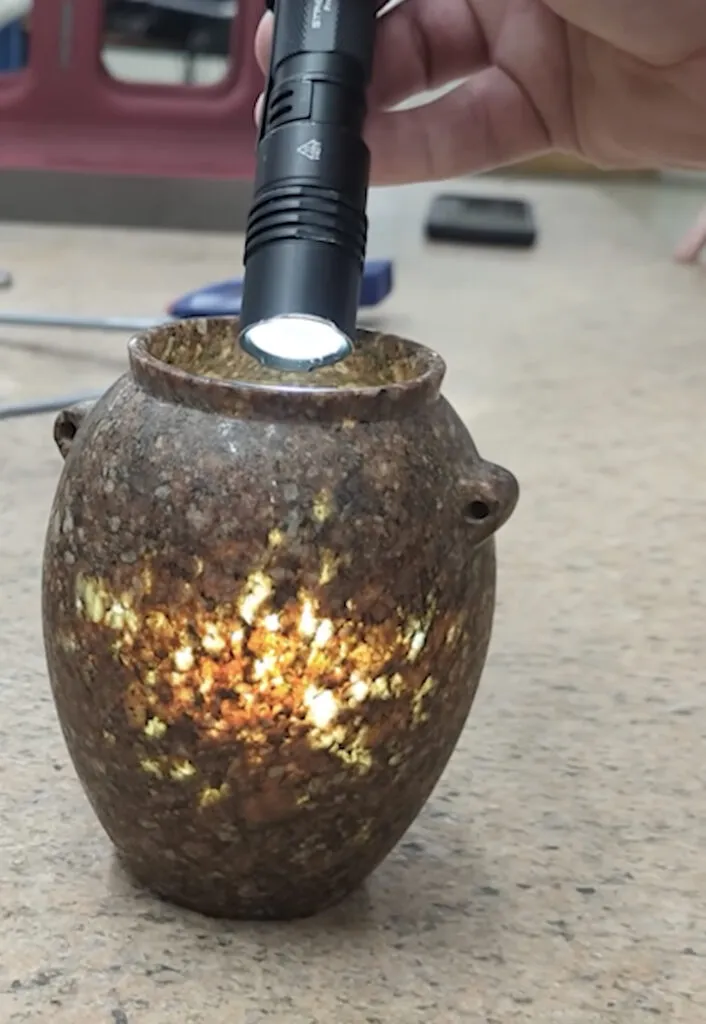
If we insist on maintaining the conventional idea that the Egyptians created works like the ones we see in the figure, using copper tools and desert sand, something doesn’t add up. In addition to the hardness of the material required to scratch a granite work, we must also consider the millimetric precision, or rather precision down to 0.4 microns, as explained in this article on pre-dynastic and Old Kingdom vases.
Image taken from the video The Tiny Ancient Artifacts Changing History! by UnchartedX, with thanks for the permission granted.
In this article, we explored the relationship between the Mohs scale, ancient stoneworking techniques, and the anomalies that seem to emerge when examining archaeological remains. The hardness of materials, as measured by the Mohs scale, provides us with a fundamental tool for understanding the technical challenges that ancient builders would have had to face. However, archaeological evidence and extraordinary achievements, such as those from Egypt and pre-Columbian civilizations, seem to go against a linear progression of stoneworking techniques.
The discovery of sophisticated techniques, followed by an apparent decline in working abilities, suggests that, instead of a continuous technological evolution, some civilizations possessed knowledge and skills that are difficult for us to fully comprehend today. The use of primitive tools like copper to work hard stones such as granite and diorite, despite the evident technical difficulties, remains an open question.
In conclusion, if we truly want to understand the capabilities of ancient builders, we must avoid simplistic conclusions and superficial approaches. The anomalies that emerge from these studies are not temporal or accidental anomalies but rather clues to a deeper knowledge that, perhaps, we have forgotten or no longer wish to explore with the seriousness and curiosity it deserves. Yet, it seems that something is finally changing, with many independent researchers revisiting a more open approach, similar to that of 19th-century scholars.