
The Delta del Diquís is one of the places with the highest concentration of the so-called stone spheres of Costa Rica, with an estimated number of over 300 across an area of 50 km² (19.3 mi²).
Dimensions
The dimensions of the spheres vary from a few centimeters to over two meters (6.6 feet) in diameter, weighing up to 15 tons (33,000 lbs).
Composition
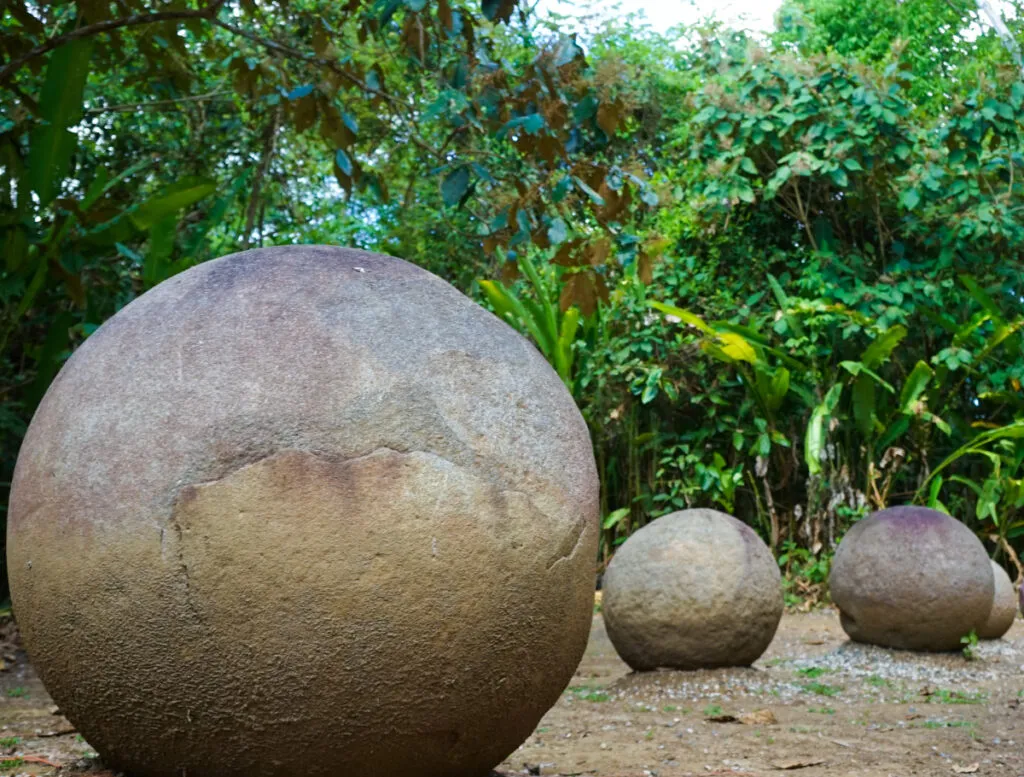
Most of the spheres are made of a rock similar to basalt, called gabbro, but some are made from much softer materials like sandstone and limestone. Some have a smooth and shiny surface while others are less refined.
To understand the complexity of crafting such precise spheres, let’s consider the Mohs scale, a scale that measures a mineral’s hardness, or its resistance to scratching by another material. The scale ranges from 1 (very soft) to 10 (very hard).
Here’s a list of minerals with their hardness numbers on the Mohs scale
- Talc – Hardness 1
- Gypsum – Hardness 2
- Calcite – Hardness 3
- Fluorite – Hardness 4
- Apatite – Hardness 5
- Orthoclase (feldspar) – Hardness 6
- Quartz – Hardness 7
- Topaz – Hardness 8
- Corundum (sapphire/ruby) – Hardness 9
- Diamond – Hardness 10
Basalt is an igneous rock that generally has a hardness between 6 and 7 on the Mohs scale, due to its content of quartz and feldspar, similarly to granite. To be scratched, materials need to be harder than these, with a hardness of 7 or higher on the Mohs scale.